
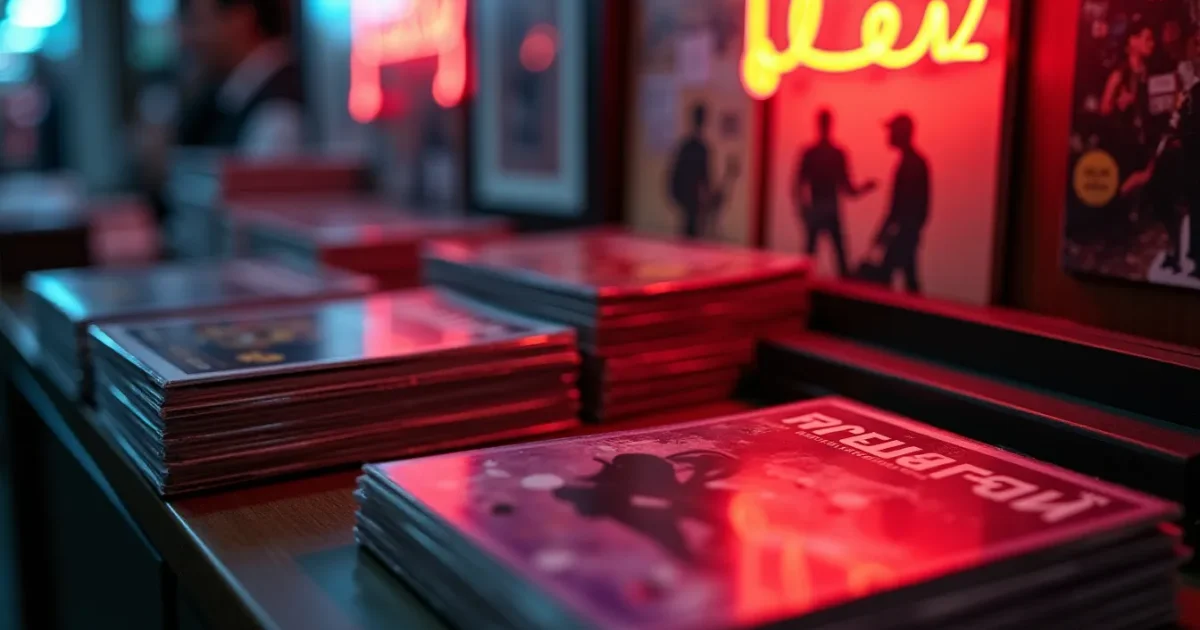
In 1991 the Moscow studio "Soyuz" released the first numbered pop compilation - a disc that started a series which ran all the way to number 62 by 2018. The "Disco 90s" compilations, the way the cassette-player generation remembers them, are not one label and not one genre but an entire industry: recording studios, distributors, kiosks and regional pirates, all splitting the dancefloor between them. Let's break down who actually assembled these discs, on what principle tracks got onto them, and why the names on the cover were not always the names in the booklet.
Who released the "Disco 90s" compilations
By the mid-1990s at least four big players worked the dance-compilation market, and each had its own series and its own chain from studio to kiosk. "Studio Soyuz", founded in Moscow back in 1988, had by 1994 grown into the Soyuz Group conglomerate with more than 50 specialist stores in dozens of cities and a turnover above 100 million dollars in 2005. Soyuz made the numbered pop series "Soyuz" (from 1991) and the dance series "Танцевальный Рай" ("Dance Paradise"). "Misteriya Zvuka" held the publishing arm, and its distributor "Misteriya Plus" carried records out to the regions. CD Land Group, founded in 1997, arrived later - but it was the first to sell albums on flash media in volume (Dima Bilan's "Believe", Alexander Rybak's "Fairytales", Ani Lorak's "Solntse"). REAL Records, which appeared on 17 February 1999 in place of ORT Records, covered the rock-pop segment with the "Nashestvie" and "Kinoproby" (a Kino tribute) series and simultaneously handled club pop through the sublabels Iceberg Music and "Zazhigay Music".
These four structures rarely worked in isolation. When Alyona Mikhailova and Liana Meladze opened the production centre Velvet Music in 2004, its releases were distributed in turn by "Misteriya Zvuka", "Soyuz", Gala Records and CD Land - that is, almost the entire compilation market of the 90s and 2000s rested on the same logistical hands. Before that, Alyona Mikhailova had run the A&R department at "Studio Soyuz" from the mid-1990s, and in 1999 took over REAL Records, which released Zemfira, "Mumiy Troll" and "Splean". Her career on its own is a map of how a person flowed between labels together with the repertoire.
Series you can verify by catalogue number
Numbered series are convenient because each one has a catalogue number and a year - you can check them in open MusicBrainz data. Here is what actually came out on "Soyuz" and around it:
- "Soyuz" (numbered pop series) - from 1991; "Soyuz 29" is dated 2002 (SZCD 1460-02), "Soyuz 32" - 2003 (SZCD 2187-03), "Soyuz 34" - 2004 (SZCD 2659-04), "Soyuz 44" and "Soyuz 45" - 2009. The SZCD prefix decodes as "Soyuz, CD".
- "Танцевальный Рай" (Dance Paradise) - a dance series: "Танцевальный Рай 1" came out in 1997 on "Soyuz" (SZCD 0847-97), "Танцевальный Рай 2" - also 1997 (SZCD 0871-97), "Танцевальный Рай 3" - 1998 (SZCD 0925-98); by number 11 in 2001 the series had moved to its own "Танцевальный Рай" label (LP-130-01).
- "Nashestvie" and "Kinoproby" - REAL Records series (1999-2018), assembled to feed the rotation of "Nashe Radio" and MAXIMUM.
- "Zvukovaya Dorozhka MK" - not a label but the chart of the newspaper "Moskovsky Komsomolets", founded in autumn 1975 by Yuri Filinov; from 1977 turned into a reader poll that has been edited by Arthur Gasparyan ever since. This chart set the "approved" set of hits from which compilation assemblers built their tracklists.
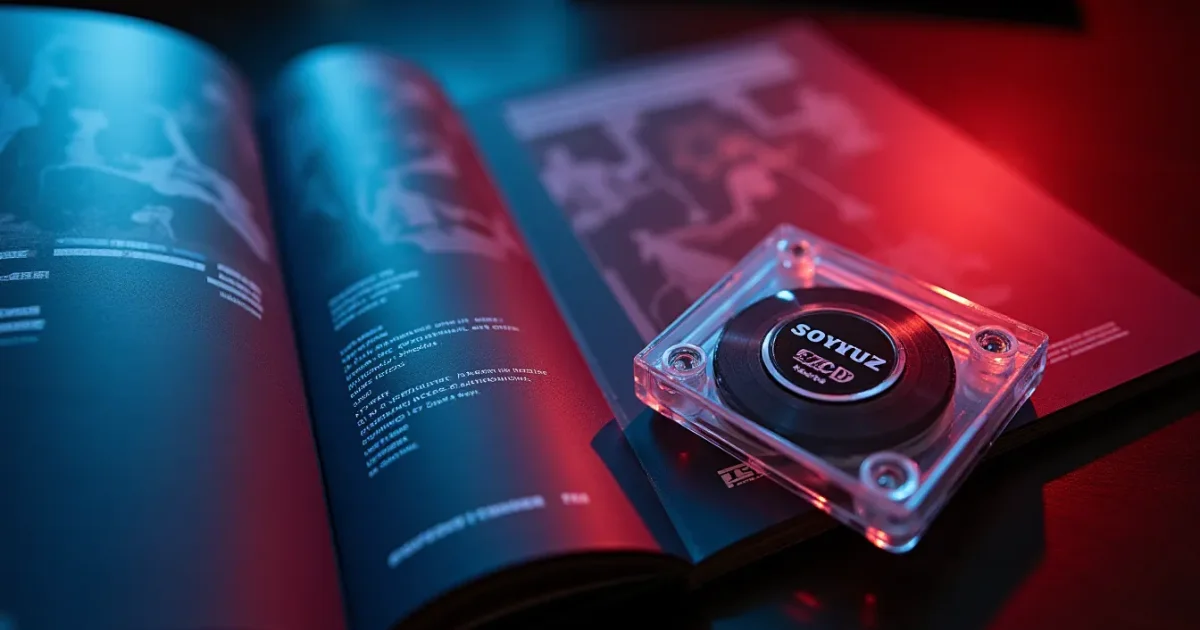
Detail: the SZCD prefix on Soyuz discs means "Soyuz, CD". If you see SZCD 0847-97, you are holding "Танцевальный Рай 1" from 1997; the last two digits of the catalogue often match the release year. Pirate re-presses do not carry such a number - they show "[no label]" or someone else's catalogue code that does not match the database.
What got onto the disc - and why
A "Disco 90s" compilation was assembled not from taste but from rights availability and chart position. A licensed disc ideally meant permission from the rights-holder for every track - but in practice the 90s market lived semi-legally, and putting together a "clean" tracklist cost more than pressing a run. So compilations were built around two sources: official charts like "Zvukovaya Dorozhka" and the label's own catalogue shelf. If Soyuz had a contract with an artist, that artist's track got into "Танцевальный Рай" almost automatically. The difference between an artist's album and a compilation in this era was not in the music but in rights and logistics - there is a separate breakdown of "album versus compilation".
The "Zvukovaya Dorozhka" chart itself mixed everything together. Already in the 1977 chart nine songs by Alla Pugacheva made the list - a single artist took up almost a third of it. In the "Best Disc" list for 1978, an ABBA album, Pugacheva's "Zerkalo dushi", David Tukhmanov's "Po volne moey pamyati", McCartney's "Wings" and Lennon's "Imagine" stand side by side - Soviet stage, Western pop and rock in one top. By the 90s the principle held: the chart took in both Madonna and Depeche Mode, "Mashina Vremeni" and Valery Meladze. The compilation assembler took from that list what worked on a dancefloor and slapped the word "disco" on the cover.
Dance series carried eurodance hits and their Russian equivalents - what chart editors called by the generic word "dance" or "techno", and what from the late 90s was retroactively called "eurodance". At the peak, in May 1995, seven eurodance songs stood in the Italian top 10 at once; the last major hit of the original sound was "Scatman's World" by John Scatman, three weeks at number one in the Eurochart Hot 100 in late August and early September 1995. After that the genre began to sag, and by the end of the decade assemblers switched to dance-pop and electro-house. Which repertoire exactly filled these series on the foreign side is easy to cross-check against the breakdown of the 90s eurodance dancefloor.
Cassette, CD and the pirate run
The format of a compilation is tightly bound to the carrier. In the first half of the 90s the magnetic carrier stayed primary - cassette compilations of the 90s moved through kiosks and markets in the millions, and the cassette was precisely the field for piracy: any stall with a double cassette deck could copy one. CD moved more slowly: a recordable CD-R cost about $12 in 1994 and only dropped below a dollar toward the end of the 90s, so a licensed "Танцевальный Рай" compact disc from 1997 was an expensive thing for many dancefloor buyers. In parallel Soyuz developed "Soyuz-Video" from 1995 - VHS and DVD with concerts, and video compilations often duplicated the audio series in repertoire, so one promoted cover worked two shelves.
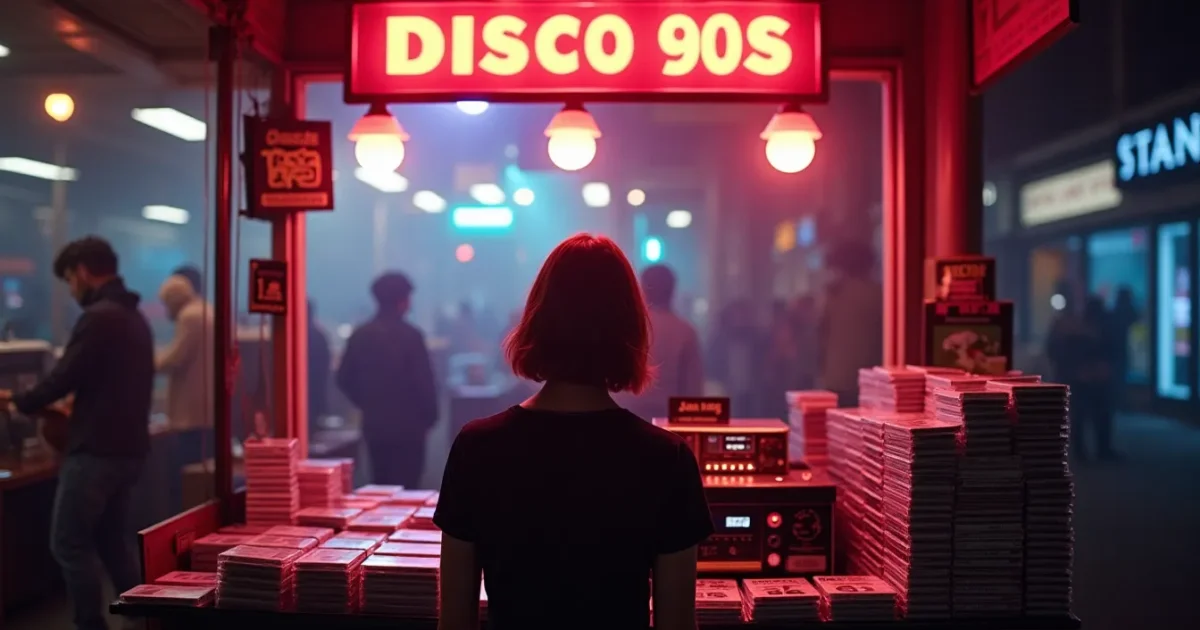
By the end of the 90s a home channel joined the regional factories: once CD-R fell below a dollar, any owner of a writing drive became a mini-label - re-recorded a licensed "Танцевальный Рай" onto a blank, printed a cover on an inkjet and sold it at half price. This was no longer one factory but thousands of small copiers, and fighting them legally was physically impossible. Soyuz's answer in the 2000s was the "mp3-collections" - discs that packed several albums in compressed form onto a single physical unit, where re-compressing already-coded MP3 degraded quality and reduced the point of copying such compilations further.
A regional pirate worked more simply: took a licensed master disc, ran it on his own lines and put his own cover on it - sometimes almost indistinguishable, sometimes with obvious blunders in the catalogue number. The matrix and numbering help tell an original from a bootleg: on genuine Soyuz discs the SZCD number is stamped on the mirror ring at the centre, while a pirate re-press either lacks it or carries a code that does not match the database. The checking technique is the same as for vinyl - worth learning how to read a carrier matrix and how to tell a bootleg from an original on concrete examples.
How the "Disco 90s 2000 compilation" wound down
By the 2000s the compilation industry was consolidating and losing volume at the same time. Soyuz closed most of its stores by 2011 - nine remained; in July 2012, 80% of the studio's shares passed to the Russian Author's Society. REAL Records lived until 5 February 2018 and was officially liquidated. The flow of physical "Disco 90s 2000 compilation" discs began to fade - it was finished off by streaming and Soyuz's own "mp3-collections", which the label launched in the 2000s, packing dozens of albums in compressed form onto one disc. Formally the "Soyuz" series ran until 2018 (62 numbers), but by then its place on the dancefloor had been taken by digital playlists.
The paradox is that the numbered series of 1991-2009 are exactly what remains as a physical trace of how the dancefloor was built. You can hold "Soyuz 29" from 2002 in your hand, and it is a document of the era - with a concrete tracklist, a concrete label and a concrete catalogue number, SZCD 1460-02, that checks out in a second. And the same principle works on the very first dance series of the line: "Танцевальный Рай 1" from 1997, SZCD 0847-97, label "Soyuz" - the disc that set the "cassette + CD + video" template which lasted the whole next five years.