
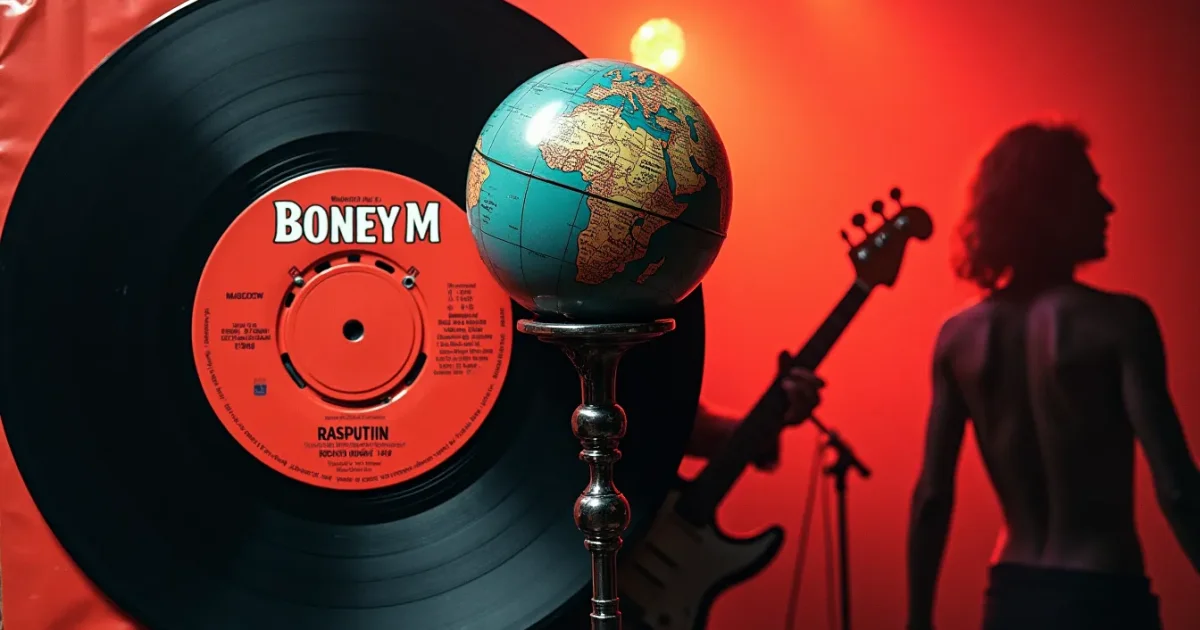
28 August 1978: the German group Boney M releases the single “Rasputin” - from the album “Nightflight to Venus”. Written by Frank Farian, George Reyam and Fred Jay. The song about Grigori Rasputin rises to №1 in Germany, Austria and Australia, №2 in the United Kingdom and Switzerland. The melody sparked a debate: critics pointed to its similarity with the Turkish song “Kâtibim”, but the band denied borrowing. “Rasputin” is not a cover of a Russian song, but it is the first case where foreign covers and Russian themes met on the international dancefloor. The two-way exchange between Russian and foreign repertoire ran in both directions - and each side has a documented history.
Foreign performers and Russian songs
“Moscow Nights” (originally “Leningrad Evenings”) - a Soviet song with lyrics by Mikhail Matusovsky and music by Vasily Solovyov-Sedoy. The British jazz trumpeter Kenny Ball recorded an instrumental version titled “Midnight in Moscow” - according to iTunes, the recording dates to 1961. Ball's version became a hit in the United Kingdom and introduced Western audiences to a melody that everyone in the USSR knew. This is a documented case: a Soviet song, reworked by a Western instrumentalist, with the original authors credited.
Another case - the song “Domovoy” by Viktor Reznikov (1988). The American group The Cover Girls recorded “My Heart Skips a Beat”, the music of which, according to Wikipedia, is a cover of Reznikov's “Domovoy” with new English lyrics. This is a rare example of reverse movement: a Soviet composition became the basis for an American pop release.
Boney M and the “Rasputin” phenomenon
“Rasputin” by Boney M is not a cover but an original song about a Russian historical figure. The lyrics describe Rasputin's rise at the court of Nicholas II: Tsarina Alexandra Fyodorovna hoped he would heal Tsarevich Alexei's haemophilia, and through this position Rasputin gained political influence. The song claims Rasputin was the Tsarina's lover - a rumour his political enemies spread to discredit him. The finale retells a popular version of his murder on 16 December 1916: conspirators led by Felix Yusupov invited Rasputin over, poisoned his wine, and then shot him. The spoken bridge belongs to Bill Swisher, Farian's American friend who served as a soldier in Germany. Swisher also appeared on other Boney M singles - “Ma Baker” and “El Lute”. Album pressings of “Nightflight to Venus” carried different versions of “Rasputin”: the first run - the full 6:26 with an instrumental interlude in the third verse, the second pressing - 6:03, subsequent ones - 5:51. The UK single edit was 5:32, most countries faded to 5:02, the French Carrere Records release was 4:45.
In 1979 Boney M toured Poland and performed “Rasputin” despite a request from government officials not to. The Sopot show was broadcast the next day on national television - with the song cut out - but it aired in full on radio, live. In Canada “Rasputin” topped the RPM Adult Contemporary chart for two weeks from 24 March 1979 and reached №7 on the RPM Top 100. In the United States the song did not chart at all. The B-side of “Rasputin” depended on territory: in Germany and Benelux - “Painter Man” (which in the UK later became an A-side single and gave the group a №10 hit in February 1979), in most other territories - “Never Change Lovers in the Middle of the Night”, in the US - “He Was a Steppenwolf”. Historian Simon Sebag Montefiore called the song “an excellent introduction to Russian court politics of the early 20th century”. The song, written in English with German and Russian words - “But the kasatschok he danced really wunderbar!” - enjoyed great popularity in the USSR and, according to Wikipedia, is credited with reviving interest in Rasputin there.
Later “Rasputin” accumulated cover versions. The Finnish folk-metal band Turisas recorded a studio version - the single came out on 31 August 2007 on Century Media, per iTunes. The band had played the cover live for several years before deciding to record it, because of positive fan feedback. The single had three tracks: “Rasputin” (3:56), “Battle Metal” (4:23) and a limited 7-inch picture-vinyl edition with “The Court of Jarisleif” on the B-side. The Spanish group Fangoria included its version on the compilation “Dilemas, amores y dramas” (2003). In February 2021 - 42 years after the original release - “Rasputin” went viral on TikTok, and the label released a new single by Majestic & Boney M “Rasputin” (26 February 2021, iTunes). The dance that accompanied the surge came from the video game Just Dance 2 (2010).
Russian performers and foreign songs
The reverse direction - Russian covers of foreign hits - has its own documented history. The group “Mirage” (Мираж), founded in Moscow in 1986 by composer and keyboardist Andrey Litjagin, borrowed its musical style from European eurodisco groups - Modern Talking and Bad Boys Blue, as the English Wikipedia article “Mirage (Russian band)” states. The debut album “The Stars Await Us” came out in 1987. Gulkina and Suhankina shared vocals; on tour the group performed to pre-recorded studio tracks, and Litjagin created several “doubles” of Mirage for simultaneous tours in different cities - among the new stage performers were guitarist Igor Ponomarev, keyboardist Roman Zhukov, dancer Svetlana Razina and “vocalists” Tatiana Ovsiyenko and Irina Saltykova. In 1988 Gulkina left the group over financial and creative disagreements. The second album “Together Again” (1988) came out with only Suhankina on lead vocals and combined Mirage's trademark eurodisco sound with the guitar rock of Alexei Gorbashov - a new style for Soviet music at the time.
These are not literal covers - Mirage did not re-record Modern Talking songs. But the structural model was borrowed: electronic rhythm section, high female vocals, melodic synth chorus. Soviet pop production replicated the eurodisco formula, adapting it for Russian lyrics and the local industry.
Sofia Rotaru, according to Wikipedia (article “Moskau (song)”), recorded a Russian-language cover version of Dschinghis Khan's “Moskau” in preparation for the 1980 Moscow Olympics. Dschinghis Khan released “Moskau” in 1979 (iTunes confirms the release date). Rotaru prepared a Russian adaptation, but due to the Western German boycott of the Olympics the recording did not receive an international release. This is a documented case: a Soviet performer making a Russian version of a German disco song written about Moscow.
Detail: “Moskau” by Dschinghis Khan and “Rasputin” by Boney M - two German disco songs of 1978-1979 about Russia, released a year apart. Both became part of Soviet musical life through cassette tapes, although neither was officially released in the USSR. Boney M, besides “Rasputin”, also released direct covers: “Kalimba de Luna” (1984) - a cover of Tony Esposito's hit of the same year. The practice of borrowing and adapting was part of Farian's producer model, and “Rasputin” stands not alone but in a row of thematic borrowings.
The modern exchange: covers as translation
In the 2020s the two-way exchange took a new form. The Disco Magic project makes covers of Soviet songs in italo-disco style: a Russian melody gets a new electronic arrangement, the lyrics stay in Russian, but the sonic language is Italian, 1983. This is not a translation and not a cover in the traditional sense: it is a transplant of a song into a different sonic context.
The other side of the exchange - translating italo-disco songs into Russian. Lyrics by Italian, German and Swedish authors who assembled English phrases by sound rather than meaning are adapted into Russian, preserving emotion and rhythm. This is not a cover (the music is not re-recorded), but it is a cultural transfer - a foreign song receives Russian verbal content.
Soviet italo-disco clones - groups similar to Mirage - represent a third route: not a cover and not a translation, but structural borrowing. “Kombinatsiya” (Saratov, 1988, producer Alexander Shishinin, composer Vitaly Okorokov), “Laskovy May”, “Tekhnologiya” - each took individual elements of the eurodisco formula and reassembled them with Russian lyrics and local producer logic. According to MTS Media, the impression from a Mirage performance pushed Shishinin to create his own group - a direct link to the source, not a guess based on a similar synthesizer.
What counts as a cover in two-way exchange
The two-way exchange between Russian and foreign repertoire does not reduce to one type. There are several levels, each with documented cases:
- Exact re-recording. Kenny Ball “Midnight in Moscow” (1961) - an instrumental cover of “Moscow Nights”. Melody preserved, jazz arrangement.
- Text adaptation. The Cover Girls “My Heart Skips a Beat” - music by Viktor Reznikov “Domovoy” (1988) with English lyrics. Melody preserved, new text.
- Style borrowing. “Mirage” (1986) - structural model of Modern Talking and Bad Boys Blue, original melodies and lyrics.
- Thematic song. Boney M “Rasputin” (1978) - an original song about a Russian figure, not a cover. Turisas “Rasputin” (2007) - a cover of that original song.
The boundary between a cover, an adaptation and a style borrowing in each case is defined by what exactly is transferred: melody, text, arrangement or only the model. Kenny Ball took the melody - that is a cover. The Cover Girls took the music and replaced the text - that is an adaptation. Mirage took the model - that is borrowing. Boney M took nothing from Russian music - they wrote about a Russian subject.
The exchange channel has not closed. When “Rasputin” by Boney M went viral on TikTok in February 2021, the dance to a German disco song from 1978 about a Russian courtier was spread by users across the world - including Russia. 42 years later the two-way exchange continues; only cassette tapes have been replaced by short videos.