
In February 1986 Prince released “Kiss”. By April it sat at #1 Billboard Hot 100 for two weeks, then returned to the top-5 for five more weeks. More important than the charts: “Kiss” was a technical experiment. On “When Doves Cry” (1984) Prince had removed the bass; here he went further - the song is built on guitar, drums, and voice. No bass, no synths, no strings. Three elements. And it worked - “Kiss” is one of the most instantly recognisable Prince hits.
Origin: a gift that was taken back
“Kiss” begins with an odd twist: Prince wrote it for someone else's band and then took it back. In December 1985 Prince was working with Mazarati - a side project of The Revolution's bassist BrownMark. Prince wrote “Kiss” as a simple acoustic song in a blues manner and gave the demo to Mazarati.
Mazarati and their producer David Z (Bobby Z from The Revolution's brother) reworked the demo. They added a drum machine, funk guitar, backing vocals - transformed a simple blues figure into a funk track. One night at Sunset Sound.
The next day Prince heard Mazarati's rework. He said immediately: “That's too good for you. I'm taking the song back”. BrownMark writes in his 2020 autobiography My Life in the Purple Kingdom: “We were shocked. We thought it was our shot. Prince just picked up the tape, drove off, and a week later the same song came out as his single. We only got a „backing vocals" credit”.
Recording: Sunset Sound, Los Angeles, December 1985
Prince reworked the Mazarati demo the same night he took the tape. He replaced the vocal (singing it himself), re-cut the guitar, and removed the bass line (again - as on “When Doves Cry”). The session ran 8 hours at Sunset Sound.
Instrumental backbone:
- Linn LM-1 - kick (on beats 1 and 3), snare (on 2 and 4). No hi-hat. The rhythm is as minimal as it gets.
- Acoustic guitar (Hohner G3T) - a funky figure, the same riff throughout the song
- Prince's vocal in falsetto - highest register, mimicking a female voice
- Mazarati's backing vocal - the only surviving piece of their version
- NO bass, NO synths, NO strings
The key move: Prince's falsetto. He sings the entire song in high octave - sounding like a female voice. Part of Prince's play with gender ambiguity: the listener can't immediately tell whether a man or a woman is singing. Gender-swap is one of the running features of the Prince 1982-90 era.
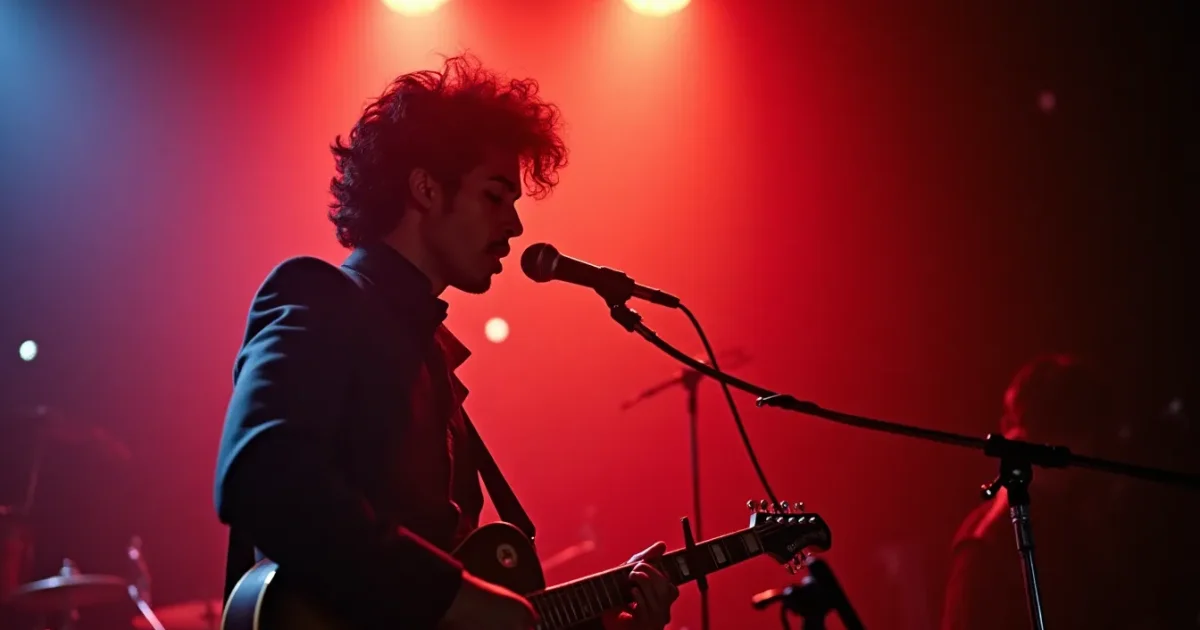
“„Kiss" is the track where I proved to myself a song can live without a bass line. I stripped everything that wasn't needed. Guitar, drums, voice. Nothing else required.”
- Prince, MTV interview, April 1986
Sound anatomy
- Key: A major, no modulations
- BPM: 110
- Length: 3:46 (single), 3:46 (album - same version)
- Producer: Prince + David Z (co-producer)
- Album: Parade (31 March 1986, Warner Bros. Records) - the soundtrack to Under the Cherry Moon
- US sales: 1 million singles (Platinum)
- Worldwide: over 3 million
- Album: 4 million copies worldwide
Chart history and Grammy
The single dropped on 3 February 1986. By 19 April - #1 Billboard Hot 100. Two weeks at the top. UK - #6. #1 in Canada, Netherlands, Switzerland. Sweden - #2.
An interesting twist: “Kiss” blocked The Bangles' “Manic Monday” from #1. Prince wrote “Manic Monday” for The Bangles under the “Christopher” alias - and blocked it with his own track. He did the same with “Sometimes It Snows in April” and “Kiss” - two Prince songs in the top-5 simultaneously in April 1986.
At the 1987 Grammys the song won Best R&B Performance by a Duo or Group with Vocals (despite being recorded by Prince alone with Mazarati backing).
Video: one dancer and one guitar
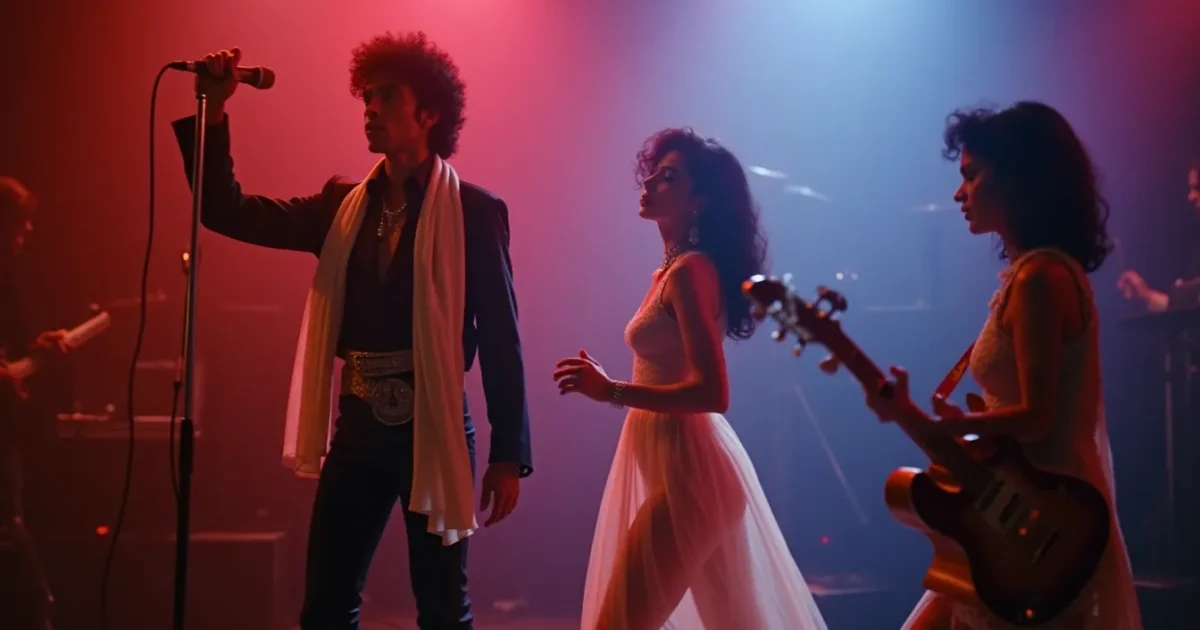
The “Kiss” video was directed by Rebecca Blake. The concept was extreme minimalism. In frame: Prince (black vest, no shirt, white scarf), guitarist Wendy Melvoin (The Revolution) with an acoustic guitar, and dancer Monique Mannen in a sheer dress. Filmed on a red background, no props.
Budget - $40,000, of which $25,000 went to lighting. Shot in one day. The clip won MTV Video Music Award 1986 for Best Male Video.
Interesting detail: Wendy Melvoin (guitarist) does not actually play guitar in the clip - she just holds it as a prop. The acoustic part on the record is Prince himself, while Wendy in the video is the “face of the band”, underscoring the androgynous image.
Tom Jones's 1988 cover: a veteran era returns
In 1988 the 48-year-old Tom Jones (a 60s pop legend) recorded a cover of “Kiss” with Art of Noise (British experimental electronic collective). The version is wildly different from the original - with a heavy bass drop, a sampled choir, and Jones's throat-shredding vocal.
Tom Jones / Art of Noise “Kiss” reached #5 UK Singles Chart and #31 Billboard Hot 100. In the UK Jones's version outsold the Prince original - 400,000 copies vs. 300,000.
Prince didn't mind. In a 1995 Q Magazine interview he said: “Tom Jones made „Kiss" his own. That's the strangest version. I love it - it has nothing to do with mine. They are two different songs on the same melody”.
“Kiss” as a concept of minimalism
“Kiss” is a key point in Prince's “less is more” philosophy. After “Kiss” Prince kept experimenting with removal: on Sign o' the Times (1987) many tracks have minimal arrangements. This philosophy shaped a generation of R&B/funk artists: D'Angelo (Voodoo 2000), Erykah Badu, The Weeknd (After Hours 2020).
Billie Eilish told NPR in 2021: “Finneas and I often play „Kiss" when we feel like we're over-loading a track. It's the best example of how to make a pop song with three elements”.
What to listen to next
For the Prince “minimalism” arc: “When Doves Cry” (1984, no bass) → “Purple Rain” (1984, 11 minutes of feeling) → “Kiss” (1986, three elements). Three stages of Prince's experiment with “what can I remove from a pop song and still have a hit”.
For “minimalism as a function” parallel, try Soft Cell “Tainted Love” (1981). Two 80s songs each built on a minimum of instruments. “Kiss” - guitar/drums/voice; “Tainted Love” - synth/drums/voice. Parallel experiments on opposite shores of the Atlantic.