
In January 1984 Van Halen released “Jump” from the album 1984. By February it climbed to #1 Billboard Hot 100 and held for five consecutive weeks. It was the first and only #1 of Van Halen's career - a band that had spent six years moving platinum albums but never topping the chart. The secret: Eddie Van Halen convinced the band to put a synthesizer in hard rock. It became a pivot moment in 1980s music - the loudest guitar player of the decade moved to the keys, and hard rock broke into mainstream radio rotation.
Eddie Van Halen: from guitar to synth
Van Halen is an American rock band from Pasadena, California. Formed in 1972 by brothers Eddie Van Halen (guitar) and Alex Van Halen (drums), with frontman David Lee Roth (vocals) and bassist Michael Anthony. By 1983 they had released five albums, every one of which went platinum in the US. Eddie was recognised as one of the greatest rock guitarists alive - the “tapping” technique he popularised changed how people played the electric guitar.
From 1982 Eddie started experimenting with keys. In a 1984 Keyboard Magazine interview he said: “I was tired of being the „guitar hero". I wanted to write songs, not solos. I bought an Oberheim OB-Xa in 1982 and played it at home for three months until my brother heard and said: „Record that"”.
Eddie wrote the “Jump” synth riff in late 1981. He played it to the band and the reaction was sharply negative. David Lee Roth writes in his autobiography Crazy from the Heat (1997): “We were a hard rock band. Synthesizers were for Duran Duran and Human League. We despised them. I told Eddie: „Forget it". He didn't forget. He kept the riff in silence for two years until we signed the new-album deal”.

Recording: 5150 Studios, November-December 1983
The album 1984 was recorded at 5150 Studios - Eddie Van Halen's home studio in Los Angeles. Eddie built the studio himself in 1982 to be independent of Warner Bros. producers.
The main instrumental backbone of “Jump” is an eighth-note synth riff on the Oberheim OB-Xa. A C-C-G-C-F-G figure in C major - so simple anyone can learn it in 10 minutes. But its effect on the listener was revolutionary: it didn't sound like rock, and it didn't sound like pop. It was a hybrid.
David Lee Roth's vocal was cut in two takes. Producer - Ted Templeman, who had worked with Van Halen since the 1978 debut. Templeman insisted on minimal processing - no effects, only Roth's raw voice. That sharpened the contrast: the synth - modern sound, the voice - classic rock.
Eddie's guitar only appears in the bridge solo - a 32-second guitar break. Eddie uses his Frankenstrat (his legendary homemade guitar), plays the tapping runs characteristic of his style. That was strategic: “if you won't accept synths, I'll give you a solo in the old style”, Eddie said.
“„Jump" is the song that split the band. Eddie wanted to evolve. I wanted to stay Van Halen as we were. We all thought „Jump" would flop. It became our biggest hit. If it had flopped, maybe we wouldn't have broken up a year later.”
- David Lee Roth, Rolling Stone, 1997
Track anatomy
- Key: C major, no modulations
- BPM: 129
- Length: 4:04 (single), 4:03 (album)
- Synth: Oberheim OB-Xa, preset “Strings 2” with light portamento
- Guitar: Frankenstrat through a Marshall Plexi and MXR Phase 90
- Drums: Alex Van Halen on a Ludwig kit
- Bass: Michael Anthony on a Music Man StingRay
- Producer: Ted Templeman
- Album: 1984 (9 January 1984, Warner Bros.)
- US single sales: 2 million copies
- Album: 10 million US copies, 20+ million worldwide
Chart history
The single was released on 19 December 1983. By February 1984 - #1 Billboard Hot 100, five weeks. UK - #7. #1 in Canada, Australia, Netherlands, Spain.
The only force that could displace “Jump” turned out to be Cyndi Lauper's “Girls Just Want to Have Fun”. The two songs duelled in the top-3 for four consecutive weeks - “Jump” at #1, Lauper at #2. “Jump” is what blocked “Girls” from the top. A noteworthy cultural moment: a hard rock band blocked a pop-feminist manifesto from the chart summit.
Video and MTV
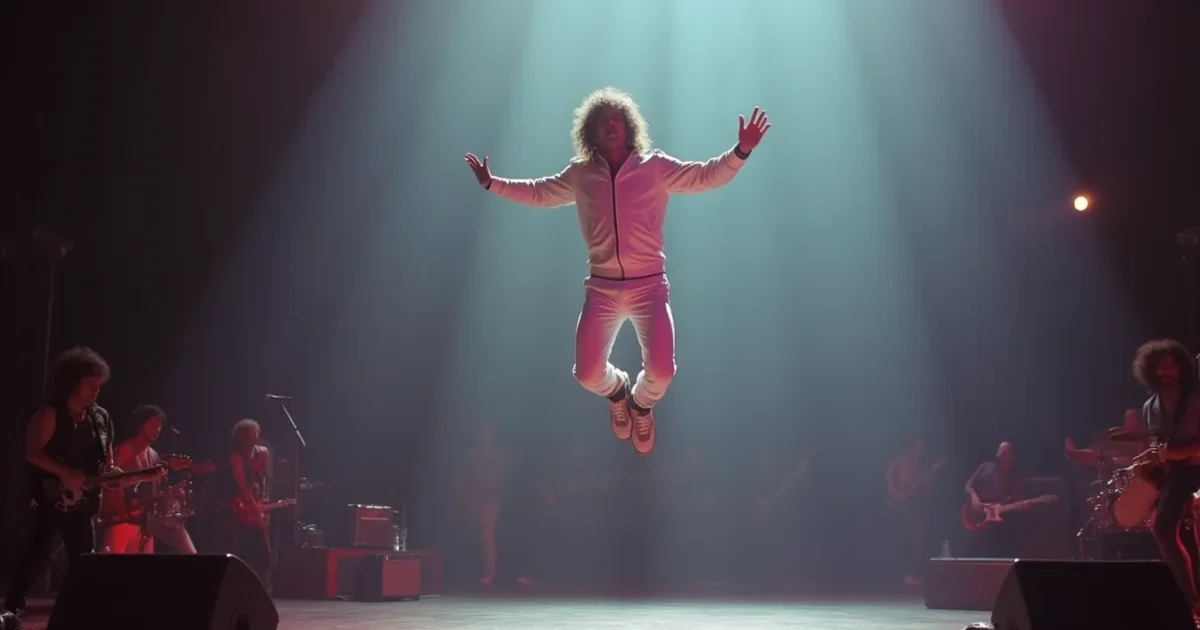
The “Jump” video was directed by David Lee Roth himself (!) - his first directing experience. Budget - $600 (!) - one of the lowest in MTV history. Filmed in 45 minutes at 5150 Studios on a handheld Super 8 camera.
The concept is about as simple as it gets: the band stands on a stage and plays the song. No plot. Roth jumps. Jumps a lot. Everyone jumps. The video is literally “the band plays „Jump" and jumps”.
MTV premiered the clip on 12 January 1984. It was in heavy rotation for four months. In 1985 it won the MTV Video Music Award for Best Stage Performance. This clip is one of the most cost-efficient in history: $600 budget against $3 million in streaming and sales.
The band split nine months later
“Jump” saved Van Halen from a commercial flop but finally broke intra-band relations. David Lee Roth left the group in April 1985 - nine months after the album's release. Reason: conflict with Eddie over direction. Eddie wanted to keep experimenting with synths; Roth wanted to return to hard rock.
Van Halen replaced Roth with Sammy Hagar and worked 11 more years. From 2004 Roth returned. Eddie Van Halen died of throat cancer on 6 October 2020 at 65.
“Jump”'s impact on the industry
After “Jump” the synth became standard in hard rock and metal. Between 1984 and 1986 hundreds of bands added keys to their sound: Bon Jovi (“Livin' on a Prayer” - see our breakdown), Journey, Foreigner, Scorpions, Europe, Deep Purple. That seeded the arena rock genre - hard rock + synth + stadium chorus.
The specific legacy of “Jump”: the simplified synth riff in C major became a template. Van Halen opened a door that 80s hard rock and hair metal walked through.
What to listen to next
For “synth in hard rock 1984-86”: Van Halen “Jump” (1984) → Bon Jovi “Livin' on a Prayer” (1986) → Europe “The Final Countdown” (1986). Three songs, each using the same move - a keyboard riff as the rock hook instead of a guitar.
To understand Eddie Van Halen as a guitarist, listen to his solo on Michael Jackson's “Beat It” (1983, our breakdown). Eddie agreed to play on “Beat It” for a case of beer - no credit. A year before “Jump”. Two Eddie solos 1983-1984 in the decade's two biggest hits.