
24 October 1983: British group Yes, prog-rock legends of the 70s, release “Owner of a Lonely Heart” from the album 90125. By January 1984 it is #1 Billboard Hot 100 (one week). It's the only #1 hit of Yes's entire career. For a band that fifteen years earlier had been playing 20-minute progressive suites with flutes, harp, and medieval themes, a hit built on Simmons drums and Fairlight stabs was a cultural shock. The classic Yes audience split - half saw the album as a betrayal, half as a second birth. And in the charts, 90125 became the best-selling Yes record ever: 3.5 million copies in the US, 6 million worldwide. The architect of the pivot is one man: Trevor Horn.
A band that almost didn't exist
By 1981 Yes had officially broken up. Their last album Drama (1980) had underperformed, vocalist Jon Anderson and keyboardist Rick Wakeman were long gone. What remained was bassist Chris Squire, drummer Alan White and two newer members: vocalist Trevor Horn (ex-Buggles, in and out on Drama) and keyboardist Geoff Downes.
In 1982 Squire and White assembled a new project called Cinema. Personnel: Squire (bass), White (drums), Trevor Rabin (guitar, vocals) - a South African guitarist previously in Rabbitt - and Tony Kaye (keys, the original 1971 Yes keyboardist). They brought in Trevor Horn to produce.
Rabin had brought a song of his own to the first session - the song that became “Owner of a Lonely Heart”. Horn heard it and said: “That's not just a hit. That's a #1.” Horn and the team then spent 18 months making the album. Not long before it was due, Jon Anderson returned from exile in Maui and agreed to re-cut the vocals. At that point the project was renamed Yes.
SARM East
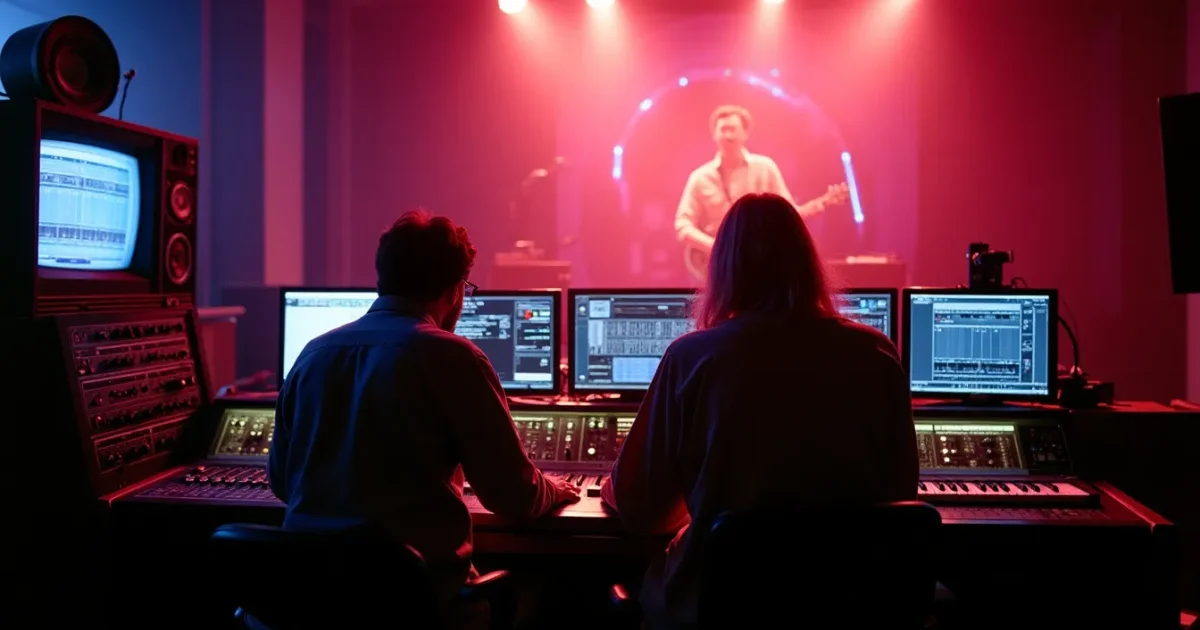
Tracking was done at SARM East studios in Dalston, London. SARM (Sound And Recording Mobile) was the studios-and-label company owned by John and Brian Lee, Horn's in-laws. It's the same room where Horn later cut Frankie Goes to Hollywood's “Relax” (1983), Art of Noise, Seal, Pet Shop Boys.
Gear on “Owner of a Lonely Heart”:
- Fairlight CMI Series II - ORCH5 stabs, background strings, “explosive” transition sounds
- Simmons SDS5 - the electronic drum system delivering the signature “boom” on transitions
- Sequential Prophet-5 - synth bass doubling Squire's live bass
- Gibson Les Paul Classic - Rabin's guitar
- Marshall JCM800 - guitar amplifier
- Neve V Series 32-channel console
- Studer A800 MK III - 24-track, slaved to a second A800
Total 90125 album budget: US$1.1 million, of which around US$180,000 went into “Owner of a Lonely Heart” specifically. Tracking stretched 16 months (January 1982 - April 1983). Horn rearranged the song about thirty times.
“Trevor Rabin brought the song in 1982. I heard it in 30 seconds and knew it was a #1. But I also knew it wouldn't be a #1 as a standard Yes-lineup record. It needed sounds nobody else had. Fairlight, Simmons, quotes from old Yes records - everything stacked and edited together so the listener couldn't pinpoint what they were hearing but couldn't stop listening”, - Trevor Horn, autobiography, 2016.
ORCH5 and the legendary stab
In the chorus of “Owner of a Lonely Heart”, just before Anderson's entry, there is a signature orchestral stab - “BAM!” - about a second long. That is the factory preset ORCH5 on the Fairlight Series II sample library: a four-second sample of a symphony orchestra playing a single fortissimo chord. Source: the finale of Stravinsky's “Rite of Spring”.
Horn used ORCH5 in a commercial pop track for the first time here. After “Owner of a Lonely Heart” ORCH5 became a universal “hit hack” - you hear it on Art of Noise's “Close (To the Edit)”, Grandmaster Flash's “Message II”, Madonna's “Express Yourself”, and on hundreds of late-80s hip-hop records. By 1990 ORCH5 was so overused that Horn stopped using it: “it became a cliché in six years”.
The fake intro and the pause trick
The track opens with a 5-second Rabin guitar riff, then 1.5 seconds of silence, then drum machine, bass, guitar and keys crash in. Horn came up with the “false start with pause” during mixing: he noticed that radio DJs typically speak over the first 5 seconds of a song. The pause mid-intro confused DJs into shutting up, so listeners heard the proper opening.
The second trick is the “chopped chorus”. In the hook “Owner of a Lonely Heart, much better than a owner of a broken heart” Horn spliced Anderson's vocal at specific syllables and inserted Fairlight samples (“uh”, “eh”, clipped from backing vocals). The listener doesn't notice - but the rhythmic structure of the chorus ends up 2% faster than the verse. Subconsciously this speeds the perception of the chorus.
Numbers
- US: #1 Billboard Hot 100 (21 January 1984, one week); 2× platinum
- UK: #28 (surprisingly low - the British Yes audience didn't accept the stylistic pivot)
- Canada: #1 RPM, three weeks
- Germany: #6
- Australia: #4
- Album 90125: 3.5M copies in the US, 6M worldwide; platinum in 9 countries
- Grammys 1985: Best Rock Instrumental Performance (“Cinema”)
Spotify 2024 - over 430 million streams. The track has shown up in films and TV ever since: The Wolf of Wall Street (2013), Dawn of the Dead (2004), American Psycho 2 (2002).
The audience split
The reaction from the classic Yes audience was icy. Yes Music Circle wrote: “This isn't Yes. This is a pop project with the Yes name on the cover.” 70s fans rejected the synthetic drums, the short tracks (4 minutes versus 20), the absence of conceptual suites. Half the audience never bought the album on CD when that format arrived.
On the other hand, 90125 brought Yes a young MTV-era audience - teenagers who'd never heard “Roundabout” or “Tales from Topographic Oceans”. The follow-up Big Generator (1987) sold a million US copies. Yes then broke up, reunited, broke up again - and the cycle continues into 2024.
“Old Yes fans never forgave me for 90125. I'm a traitor to them. New Yes fans never came to love Fragile. It's one band with two audiences that hate each other”, - Trevor Rabin in Classic Rock, 2015.
What “Owner of a Lonely Heart” gave pop
The track proved: a progressive band can cut a 4-minute pop hit if they find the right producer. It influenced Genesis (“Invisible Touch”, 1986), Heart (“These Dreams”, 1986), Whitesnake (“Here I Go Again”, 1987) - all following the Yes path: prog inheritance, radio format, Fairlight production.
Related: Trevor Horn and ZTT, Fairlight CMI, “Billie Jean” Michael Jackson. The main lesson of “Owner of a Lonely Heart” is that technology and a producer's will outweigh genre heritage. 1972 Yes and 1983 Yes are two different bands under one name. And no fan is ever going to reconcile them.