
2 January 1983: the single “Billie Jean” by Michael Jackson is released in the US as the second single from the album Thriller (out 30 November 1982). Seven weeks later it hits #1 Billboard Hot 100 and holds there for seven consecutive weeks. UK: #1, one week; Canada: #1, five weeks; Australia: #1, three weeks. The video, directed by Steve Barron on a US$250,000 budget, becomes the first video by a Black artist in MTV's heavy rotation - an event that in March 1983 physically broke the channel's “no-Black” policy. By 2024 the album Thriller has sold over 70 million copies and remains the best-selling album in history. “Billie Jean” is not just a track. It is the specific moment when pop music, MTV, and mass culture merged.
How Quincy Jones turned down “Billie Jean”
Tracking for Thriller started in April 1982 at Westlake Recording Studios in Los Angeles. Producer - Quincy Jones (born 1933), working with Jackson since Off the Wall (1979). The team: engineer Bruce Swedien, keyboardist Greg Phillinganes, guitarist Steve Lukather, drummer Leon “Ndugu” Chancler.
Jackson had written “Billie Jean” in summer 1982. He made a demo at his house in Encino on a 4-track. The structure was already in place - bass line, vocal, drum pattern. Jackson brought the demo to Jones on the first day of sessions. Jones listened and said the track was weak.
“I told him: "Michael, you've got a bass riff playing for 29 seconds of intro. No one's going to wait 29 seconds for the melody." Michael replied: "Quincy, it's my track. You leave it alone." It was the first time I saw him dig in. It was the only time in all our years together”, - Quincy Jones in the autobiography Q (2001).
Jones relented. The 29-second intro stayed - Louis Johnson's bass line plus Ndugu Chancler's drum pattern. That intro became one of the most recognisable in twentieth-century pop.
Louis Johnson's bass line
Louis Johnson (1955-2015) - bass player with Brothers Johnson, session work with George Benson, Quincy Jones, Bob James. On “Billie Jean” he used a Yamaha BB-1200 - a rare Japanese bass from 1981, which Johnson had bought for US$1,100 right before the session.
The bass part sits on a single note (F#) repeated sixteenth notes, with accents on 1 and 3. Between verses Johnson adds a brief slide up to A and back. It sounds like the simplest figure imaginable - but sessioneers trying to copy it exactly (especially the tone) have come up short for 40 years.
A synth bass overlay was played by Tom Bähler on a Sequential Prophet-5. He doubles the live bass an octave down, adding “weight”. The combination of the Yamaha BB-1200 and the Prophet-5 produces the characteristic “subterranean” quality of the “Billie Jean” bass - no clone since has matched it.
Ndugu Chancler's drums
Leon “Ndugu” Chancler (1952-2018) - session drummer with Santana, Herbie Hancock, George Duke. On “Billie Jean” he didn't use an LM-1 or LinnDrum - the part was played live on a drum kit: Yamaha 9000 Series, Zildjian cymbals.
The signature “kick-snare-kick-snare” sixteenth-note figure was cut in a single session - seven minutes of continuous playing, with the finished track built around a four-bar loop from the middle. Chancler played to a click in the cans at 116 BPM while Swedien recorded to a Studer A800 24-track. The kick sounds muffled because a felt pad was taped across the head - Chancler's trick to kill the ring.
91 vocal takes
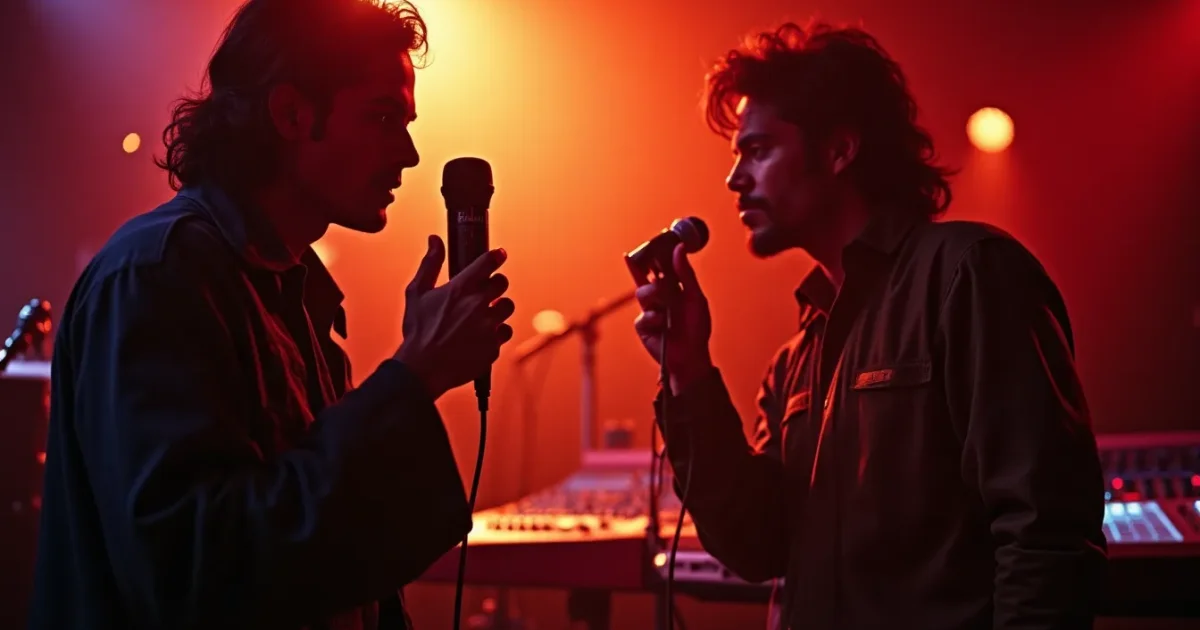
Jackson tracked the vocal during a February 1982 session. According to the full session log that Swedien preserved, Jackson did 91 takes of the lead vocal before approving the final one. For comparison: a session singer averages 5 to 10.
The reason: Jackson was chasing perfect phrasing. The line “She came and stood right by me” has a rhythmic lean on “right” - Jackson repeated it 17 times to find the exact stress point. The signature vocal “eeh-heeh” breaths (after each chorus) were not added in mixing. They're on the tracked vocal, improvised in the moment.
“Michael sang the same line thirty times over. I thought: he's losing it. Then I'd hear: each variation was subtly different - tone, breath, accent. He was picking the most exact one. It was a mathematical approach”, - Bruce Swedien in Mix Magazine, 2003.
Steve Barron's video and MTV's racial line
The video was directed by Steve Barron, an Irish director who'd later also do a-ha's “Take On Me” and The Human League's “Don't You Want Me”. Budget for “Billie Jean”: US$250,000 (three times a typical 1982 video budget). Shot in Los Angeles in October 1982 over three days.
Concept: Jackson walking down a night street, tiles lighting up as his feet land, an unknown photographer in pursuit. The lighting tile effect was produced by a stencilled array of lamps under glass, timed to Jackson's steps - 14 hours of frame-by-frame editing.
In March 1983 MTV's management (under Bob Pittman) initially declined to put the clip in rotation. Official reason: “rock format restricts black artists”. CBS Records chief Walter Yetnikoff phoned and said: “If you don't play Billie Jean, we pull every one of our clips from MTV - Mick Jagger, Bowie, Billy Joel, everyone.” MTV yielded. “Billie Jean” went into heavy rotation on 10 March 1983. It was the turning point of MTV's racial politics.
Numbers
- US: #1 Billboard Hot 100 for 7 weeks (March-April 1983); 2× platinum
- UK: #1, 1 week; silver
- Canada: #1, 5 weeks
- France, Australia, New Zealand: #1
- Germany: #2
- Album Thriller: 104 weeks on Billboard 200 (37 weeks at #1); 70M+ copies worldwide
- Grammys 1984: 8 awards, including Album of the Year
Spotify 2024 - over 1.2 billion streams for “Billie Jean”. YouTube video - 1.1 billion views by November 2024.
What “Billie Jean” did to pop
The track set a production standard that would haunt pop for forty years: a foregrounded bass for the whole song, a live drummer with exact repeatability, vocal as the primary instrument, melody not sacrificed for danceability. Every pop record from 1983 to 2000 was measured against “Billie Jean” and either matched it or lost the comparison.
Related: “Good Times” Chic, “Owner of a Lonely Heart” Yes (1983), “Sledgehammer” Peter Gabriel. Michael Jackson died on 25 June 2009. Six months later Thriller was back at #1 on the Billboard 200 - the rare case of a triumphant return after death. “Billie Jean” remains the one song Michael Jackson said, in interviews, he “didn't remember writing” - the melody, he said, “came when I was driving down the 405 freeway”.