
June 1985, Milan: EMI Italiana releases the debut single of the project Baltimora - “Tarzan Boy”. The face of the band is 28-year-old Irish dancer Jimmy McShane, from Derry, resident in Italy since 1981. The single goes #1 on the Italian chart fast. By summer 1985 it's #3 in the UK; that autumn, #13 Billboard Hot 100 in the US. Global sales by late 1986 exceed 3 million copies. McShane is on every cover, every video, every MTV spread. But on the record, he is not the one singing.
Who actually made Baltimora
Baltimora was conceived by two Milanese producers: Maurizio Bassi (composer, former keyboardist of Stormy Six) and Giorgio Spagnol (arranger, previously with Al Bano). They needed a front - telegenic, charismatic for MTV. Through an agency they found Jimmy McShane, then working as a backup dancer for Italian pop singer Ivan Cattaneo.
The “Tarzan Boy” lead vocal was recorded by Maurizio Bassi himself. McShane supplied backing vocals and the signature “oh-oh-oh” shouts. That fact was kept confidential until 1993 - the public assumed McShane was the singer because he lip-synched on every video and every television appearance.
One detail: in early 1985 Italian interviews McShane was asked directly - “Are you really the one singing?” - he deflected and changed the subject. The Italian press knew the truth and sat on it by agreement with EMI.
How the arrangement works
The track rests on three elements:
- The yodel intro - Bassi sang it himself, imitating the Tarzan cry from Johnny Weissmüller's 1930s films
- Bass line - Sequential Circuits Pro-One, a looped arpeggio on Am-F-C-G
- Drums - LinnDrum LM-2 with a signature clap on 2 and 4, 120 BPM
Orchestra stabs came from a Fairlight CMI Series II. Electric piano - Yamaha DX7, preset E.PIANO 1. Guitar - an actual Fender Stratocaster through a Roland Jazz Chorus JC-120 with chorus. Recording took two weeks in September 1984 at Angelo Carrara studio in Milan. Budget - 22 million lire (about US$13,000 in 1984 money).
The lyric and “Tarzan Boy” as code
The English lyric was written by John Aussiello, an American copywriter living in Milan. “Tarzan Boy” started out as a placeholder name: Bassi and Spagnol had wanted to make a children's reworking of the hymn “Jungle Boogie”, but after hearing a Fairlight factory preset with a yodel sound they pivoted to an ironic reference to the Weissmüller films. The “oh-oh-oh, oh-oh-oh” line is the attempt to mimic a jungle cry without words.
“We weren't trying to write a serious song. We wanted teenagers in clubs to shout "ah-ah-ah-ah" in the chorus. Everything else was an accident”, - Maurizio Bassi to Raro! in 2008.
The MTV-ready video
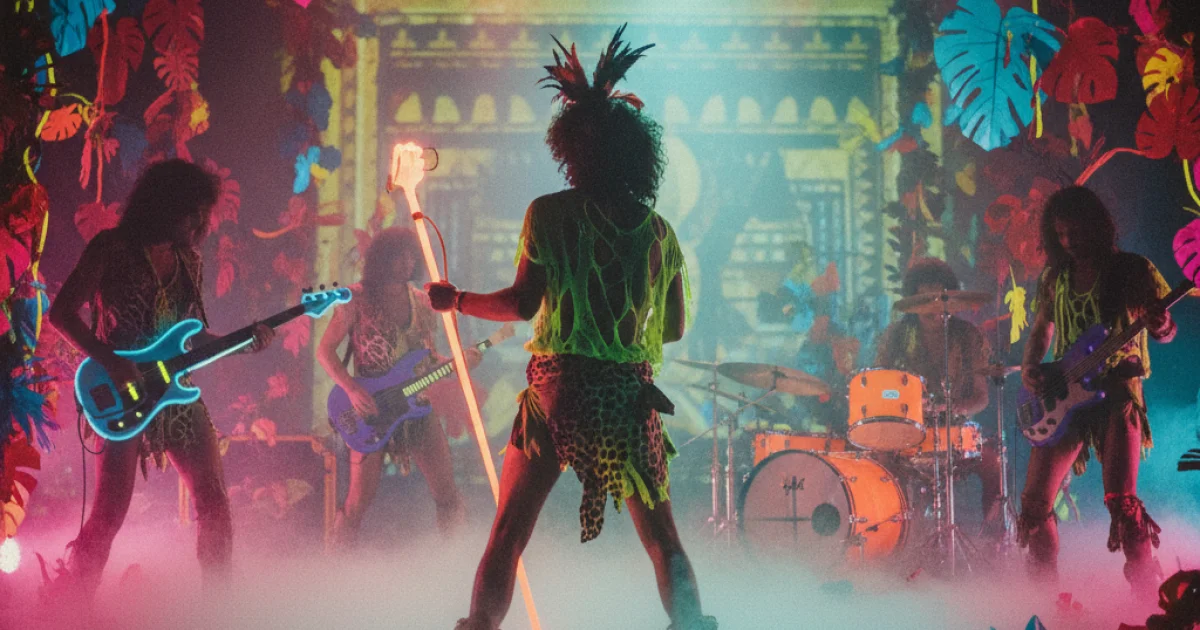
Director Rodolfo Martini shot the video in summer 1985 on the Cinecittà soundstages. The look - stylised jungle in neon colours: plastic vines, fog machines, dancers in leopard prints. Budget: US$85,000. McShane on the dance floor, in a bleached afro and a ripped denim vest.
MTV picked it up in July 1985 and pushed it into heavy rotation. It was one of the first Italian videos MTV programmed alongside American ones without discount. By September “Tarzan Boy” was in the Billboard top 20, in October at #13. The album Living in the Background hit #28 on the Billboard 200 - a rare American breakthrough for an Italo-disco act.
The numbers
- Italy: #1 FIMI, six consecutive weeks (July-August 1985)
- UK: #3 UK Singles Chart (August 1985)
- US: #13 Billboard Hot 100 (November 1985); gold
- Canada: #4
- Germany: #2
- Netherlands: #1, four weeks
- Australia: #19
- Brazil: #7
Global sales of “Tarzan Boy” by late 1986 - 3.2 million copies. The album Living in the Background - 1.8 million. Peak numbers for any Italian synthpop band of the 80s, higher than Ryan Paris, Gazebo, or Sandy Marton.
The second album and the collapse
In 1987 Baltimora released a second album, Survivor in Love. Bassi and Spagnol tried to repeat the formula, but the public had already stopped believing that McShane was behind the microphone. In 1988 the Italian magazine Ciao 2001 directly accused the project of fraud: “Baltimora is a phantom, McShane is a face on the cover, the singing is session work.” EMI chose not to sue.
The second single “Survivor in Love” only reached #21 in Italy and didn't chart in Britain or the US. By 1989 Bassi and Spagnol had dissolved the project. McShane returned to the dance scene.
McShane's death
Jimmy McShane died in Ireland on 28 March 1995 from complications of HIV infection, aged 37. For a long time his death was not publicised: Italian obituaries appeared only in May 1995, British ones in July. McShane was openly gay in an era when Italian showbusiness demanded discretion; in a handful of late interviews in 1993 he spoke about it openly, knowing his career was already over.
“Jimmy was a great dancer and a poor singer. All he did for Baltimora was give the tracks the face the audience wanted. And that was enough for three million copies”, - Maurizio Bassi to La Repubblica after McShane's death.
“Tarzan Boy” after 1995
In 1991 the track turned up in Teenage Mutant Ninja Turtles II: The Secret of the Ooze - the sequence where the turtles emerge from the sewers. That triggered a second life: the ten-year-olds of 1991, having seen the film, rediscovered the song. The “Summer Mix '93” remix reached #51 on the Billboard Hot 100 after McShane's death. A 2007 US Listerine ad used the hook - US$2.5 million in posthumous royalties.
By 2024 the original has over 320 million Spotify streams. Related pieces on Italian hits from the same window - “Voyage Voyage” Desireless, “Self Control” by Raf and Laura Branigan. Baltimora is a textbook Italo-disco “one-hit wonder”: one track, three million copies, and an authorship riddle that was only spoken aloud eight years after the frontman's death.