April 1983, Rome: Discomagic Records issues the single “Dolce Vita” by Ryan Paris - stage name of Fabio Roscilli, a 27-year-old Milanese singer. Composer and producer: Pierluigi Giombini, the same man who a year earlier had made “I Like Chopin” for Gazebo. Over summer 1983 the single hits #5 in the UK, #1 in West Germany, #1 in France, #4 in Belgium. Total sales by end of 1984 - over 2.5 million copies. On Soviet cassette compilations from 1986-1988 “Dolce Vita” ranks in the top ten of the most commonly copied Italo-disco tracks.
The Giombini formula
Pierluigi Giombini (born 1956, Rome) is a composer and arranger trained at Santa Cecilia. Across 1982-1984 he writes three singles that define the Italo-disco canon:
- “I Like Chopin” for Gazebo (1983) - #1 Italy, #4 UK
- “Masterpiece” for Gazebo (1983) - #12 Italy
- “Dolce Vita” for Ryan Paris (1983) - #5 UK, #1 Germany
All three use the same arrangement template:
- Piano intro: Yamaha CP-80 or DX7 E.PIANO 1, arpeggiated minor chord
- Octave bass: Roland Jupiter-8, on beats “one” and “three”
- 118 BPM tempo: LinnDrum LM-2, signature clap on 2 and 4
- String pad: Roland Jupiter-8, PWM, long release
- Key change: minor verse, relative major chorus
Giombini called this formula melanconia italiana - Italian melancholy - in contrast to the “German melancholy” of Bohlen, built on faster tempos and minor-key choruses.
Who Ryan Paris is
Fabio Roscilli was born in Milan in 1956. Before 1982 he was the frontman of several failed rock bands. In 1982 he met Giombini in the Rome club Easy Going and proposed a joint project. The stage name “Ryan Paris” was Roscilli's own idea, taken from the 1951 Hollywood film A Place in the Sun with Montgomery Clift - the film's protagonist was called Eastman, but Roscilli didn't like the name and swapped it for “Paris” after the French capital.
Worth noting: Giombini originally offered the track to Sabrina Salerno, who declined - afraid it would flop. Eighteen months later she released “Boys” and became one of the biggest Italian disco stars.
Recording “Dolce Vita”
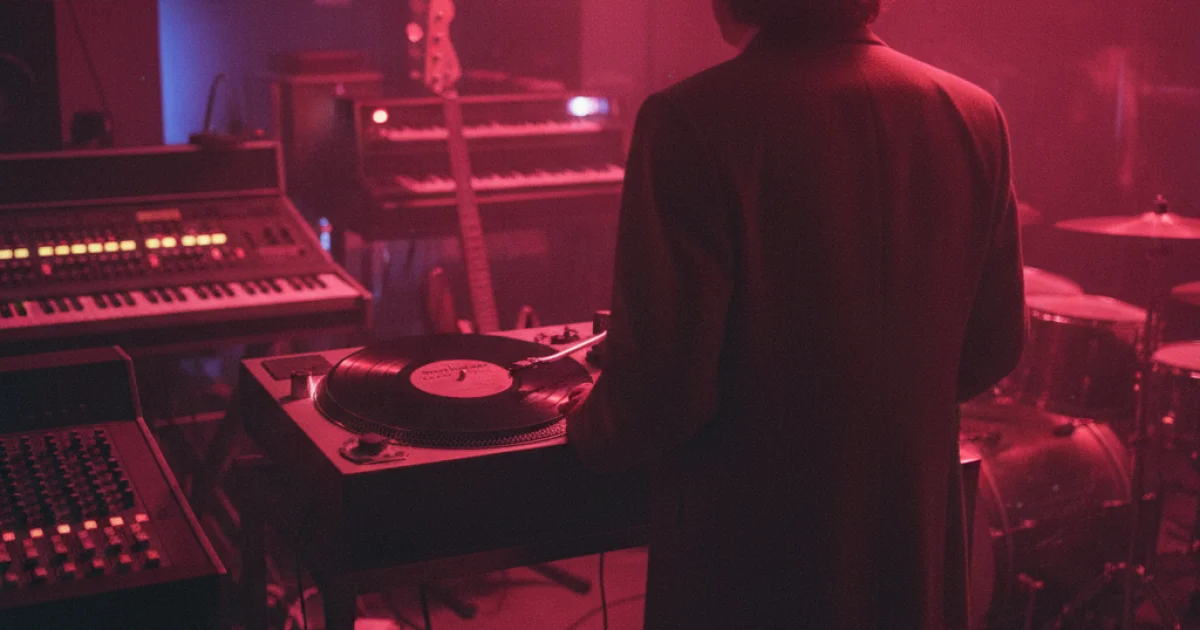
Sessions took place January-February 1983 at the Rome studio Mondial Sound. Equipment list:
- Yamaha DX7 - intro electric piano, preset E.PIANO 1
- Roland Jupiter-8 - string pad, bass, lead solo
- LinnDrum LM-2 - drums, clap / hi-hat / kick presets
- Yamaha CS-80 - orchestral stab in the chorus
- Budget: 28 million lire (about US$18,000 in 1983)
Recording ran eleven days. Roscilli tracked vocals over two days - he said he couldn't sing over a synthetic beat for more than four hours at a stretch, that his ears tired of the monotonous LinnDrum clap. The English lyric was written by Paul Mazon-Baïsse, an English lyricist living in Rome since 1979, for a flat fee of 2 million lire.
How the listener experiences “Dolce Vita”
The intro is 12 seconds of solo piano in Am. After the second bar - a Jupiter-8 bass drop. At 0:24 the LinnDrum arrives. At 0:32 - first verse, Roscilli's voice low in his register. 1:08 - a lift into the chorus through a third up. The chorus sits in C major, on C-E-G, with a dominant synth stab. At 1:53 back to Am for the second verse. At 3:40 - the key move: a semitone modulation up from Am to A#m, which was unusual for 1983 (most Italo-disco tracks stayed in a single key).
“I came up with the semitone modulation on the last day of recording. By the third listen your brain tires, and the modulation freshens the chorus again. It's an old trick from 60s variety songcraft - I applied it to the discotheque”, - Pierluigi Giombini in Suono Magazine, 2010.
The numbers
- Italy: #6 FIMI (May 1983); gold
- UK: #5 UK Singles (October 1983); silver
- Germany: #1, four weeks (July-August 1983); 3× gold
- France: #1, three weeks; platinum
- Belgium: #4
- Netherlands: #6
- Austria: #2
- Switzerland: #5
- Spain: #12
Worldwide sales by end of 1984 - 2.6 million copies. Ryan Paris's best-ever figure and one of the two biggest-selling Italo-disco singles of 1983 (the other being “Self Control” by Raf).
What came next for Ryan Paris
1984 brought the single “Fall in Love” - #11 Germany, #34 UK. 1985: “Tu Sei l'Unica Donna per Me” - #15 Italy, no chart entries elsewhere. By 1986 the project had effectively dissolved: Giombini moved on to other artists, Roscilli kept recording occasional solo singles with no commercial impact.
Ryan Paris revived the project in the 2000s, touring nostalgia disco festivals across Europe. In 2019 a remix “Dolce Vita 2020” with Giovanni Damico reached the German Dance Chart top 30. By 2024 the 1983 original has over 95 million Spotify streams.
Place in the Italo-disco canon
“Dolce Vita”, alongside Gazebo's “I Like Chopin”, is considered the yardstick Italo-disco sound of 1983: melancholic piano, Jupiter-8 pad, syncopated clap, bilingual (Italian-English) lyric, slow approach into the chorus. Hundreds of Italian producers used the template to the end of the decade. Giorgio Moroder in 1977 invented the synthetic disco foundation; Giombini in 1983 added piano lyricism - the result was the recognisable European pop sound for a decade.
Neighbouring pieces - “Major Tom” Peter Schilling (1982), “Self Control” Raf (1984).