1998. 26-year-old Aleksandr Makhonin from Yekaterinburg, known under the stage name Mr. Credo, releases the album "Zolotoe Vremja" ("Golden Time") - and on it sits "Vozdushnyj Shar" ("The Balloon"), the song that will define the rest of his career. Two years earlier Makhonin had disbanded the dance-lyric group "Kredo" and moved into "techno-rave with elements of ethno and the East" - "Vozdushnyj Shar" becomes the best-known realisation of that new direction. iTunes confirms: the track sits on "Zolotoe Vremja" alongside "Koza Nostra", "Carlos Kastaneda" and "Mama Azija".
"Vozdushnyj Shar" is the point where three contexts collapse into one: the Ural electronic scene of the mid-1990s, Makhonin's stylistic pivot from dance lyricism to techno-rave, and a production model in which the author, the performer and the producer are the same person. No outside composer: music, lyrics and arrangements are all Makhonin. This is a structural difference from the Moscow producer projects of the same period, where "the face" and "the hands" are split.
Before "Kredo": the rock band "Aspekt" and military school
Aleksandr Valer'evich Makhonin was born on 22 November 1972 in the Chudnovskij district of the Zhitomir region of the Ukrainian SSR. As a child he moved with his parents to the Urals - first to the closed town Kosulino-1 (now the settlement Ural'skij), then to Sverdlovsk. In 1988 a rock band called "Aspekt" formed in Sverdlovsk, with Makhonin as songwriter and vocalist. A first magnetoalbum in a "rock" style was recorded at the rock centre "SFINKS".
In 1990-1991 Makhonin is a cadet at the Perm Higher Military Command-Engineering Red Banner College of the Strategic Rocket Forces, named after Marshal Chujkov. Rocket school, a rock band, a future techno-rave act - a career zigzag that Makhonin's biography explains only by an internal need for music: he returns from the army to Sverdlovsk already with a plan for his own project.
Detail: the stage name "Mister Credo" is taken from the perfume Credo by the Latvian firm "Dzintars". Not from the Latin "credo" - "I believe" - but from a fragrance brand. This matters: Mr. Credo's whole image is built on the aesthetics of cologne and an Arabian keffiyeh, not on religious rhetoric.
1993-1996: the group "Kredo" and the first pivot
In 1993 Makhonin forms the group "Kredo" and records a first magnetoalbum. In 1994 the first CD album "Garmonija" ("Harmony") is recorded (Makhonin's discography lists it under 1995). This is still dance lyricism - a format in which Makhonin feels constrained. In 1995 he takes part in shooting the pilot episode of the music TV show "Pilot" on the NTV channel (author: A. O. Tabakov). In 1996 "Kredo" disbands.
The break-up coincides with a radical style change. Makhonin drops dance lyricism and moves to "modern techno-rave with elements of ethno and the East". That same 1996 he performs at a Bad Boys Blue concert at the "Kosmos" hall in Yekaterinburg - already in his new guise, on the same stage as a European disco group. In 1997 the album "Fantasy" comes out on the label AVA Records, a video is shot for the song "HSH-Bola".
What exactly changes in the sound
The transition from "Kredo" to solo-project Mr. Credo is not a tempo change but a palette change. Compare "Garmonija" (1994) and "Zolotoe Vremja" (1998): the first record sounds like European dance pop in the spirit of Bad Boys Blue, the second has Eastern modes, a keffiyeh in the video and lyrics that critics will later tie to drug themes. Technically the shift looks like this:
- Rhythm - from a straight disco beat to broken techno-rave patterns with a galloping bass; tempo sits in the 130-138 BPM corridor, but the feel is different - because of the syncopation and density;
- Melodics - Eastern modes (Phrygian dominant, hijaz) instead of major-minor European harmony; this is audible in "Vozdushnyj Shar" in the bridge;
- Timbres - samples of Eastern winds and strings (duduk, oud), synth pads with a long attack, a characteristic "desert" reverb;
- Vocal - a chanting, almost spoken-word delivery instead of lyrical singing; Makhonin does not "sing" in the classical sense - he intones the text over the beat;
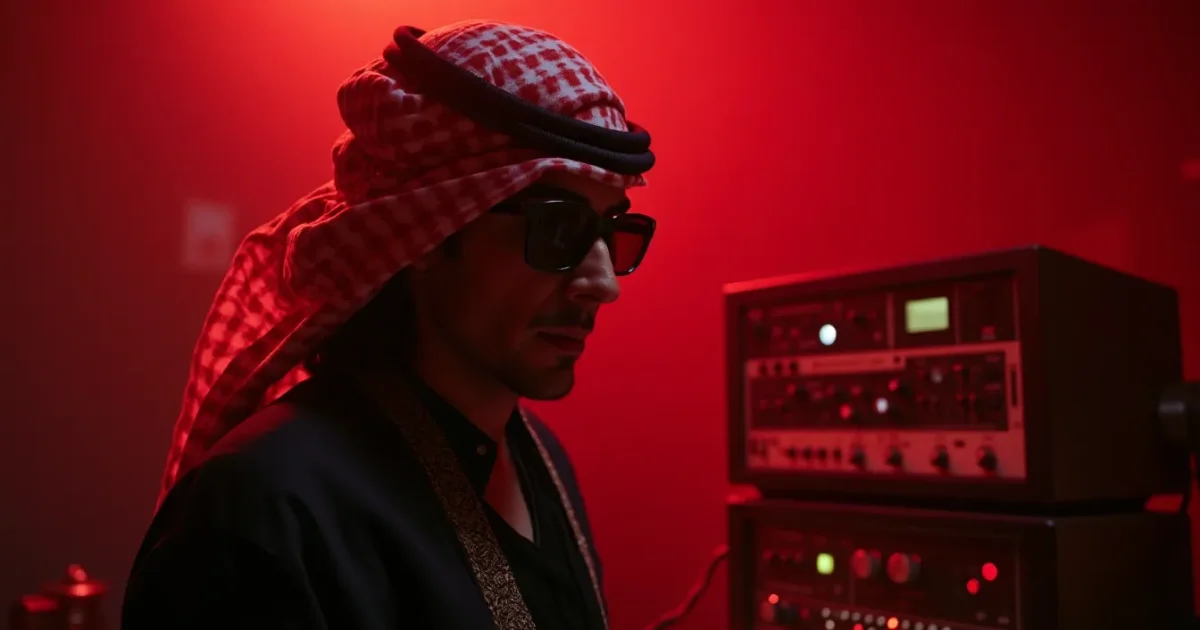
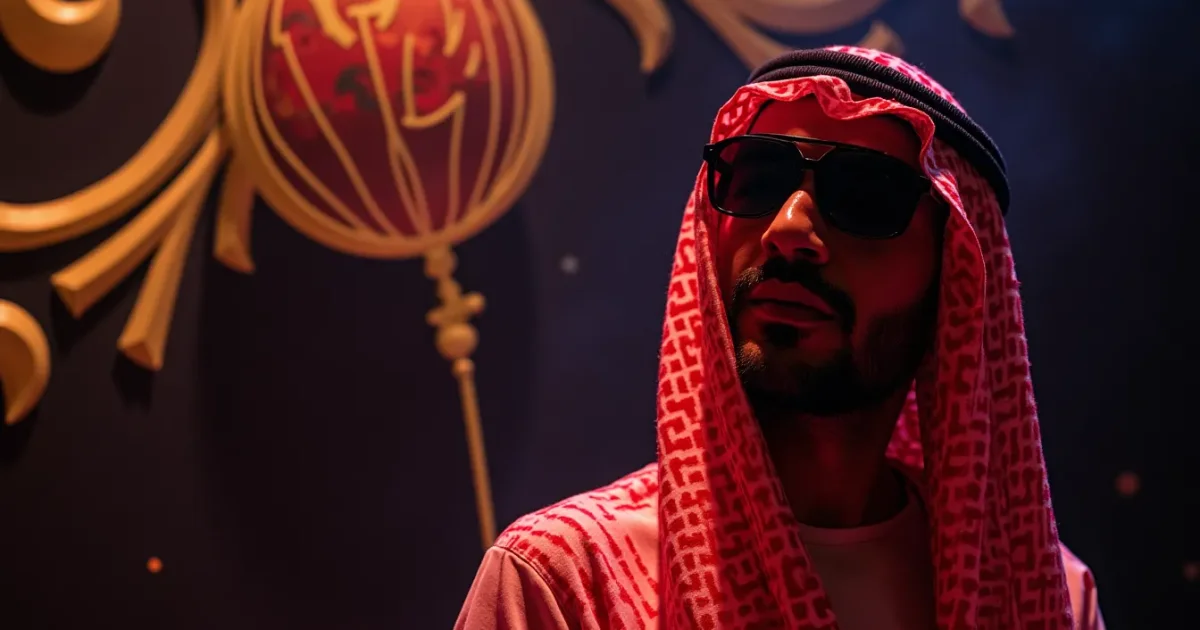
- Stage image - Arabian keffiyeh and black sunglasses; the image works as optics: the viewer immediately understands this is "Eastern techno-rave" before the beat even drops.
"Vozdushnyj Shar" is not the most radical track on "Zolotoe Vremja" (next to it sit "Mama Azija" and "HSH-Bola" with a much harder delivery), but it is the one that becomes the calling card: in it the Eastern melodics and the techno-rave rhythm are balanced so the track lands in radio rotation. Radio in 1998 picks "Vozdushnyj Shar" - not "Koza Nostra" and not "Mama Azija".
1998: "Zolotoe Vremja" and three videos
1998 is a turning point for Mr. Credo. The album "Zolotoe Vremja" comes out, and three videos follow at once: "Vozdushnyj Shar", "Cosa Nostra" (in Russian transliteration "Koza Nostra") and "Mama Azija". iTunes confirms the album's tracklist: "Vozdushnyj Shar", "Koza Nostra", "Carlos Kastaneda", "Derzhi, Bakshish!", "More Ostrykh Oshchushchenij", "Doktor Ajbolit", "Dolgaja Doroga V Djunakh" - the digital release is dated 15 March 2012, but the original 1998 album carries exactly this set of songs. Content-wise the record is a conceptual ride through "Eastern techno-rave": from "Vozdushnyj Shar" to "Mama Azija" there is one optical line.
Whether the videos were shot in one cycle - sources do not say, but visually they are clearly from the same series: keffiyeh, black sunglasses, Eastern ornaments, post-Soviet psychedelia. The director and budget of the videos are not documented in open sources - treat those figures with caution if you come across them. What is known is different: "Vozdushnyj Shar" gets rotation on MTV Russia and lands on dance-music compilations of the late 1990s - that is its cultural niche.
What is sampled - and what is not
The question of samples and borrowings in "Vozdushnyj Shar" is one of those that the internet discusses confidently but without sources. Specific samples the track is built on are not registered in open databases (Whosampled, Discogs). This means only one thing: in this article we write about what is confirmed, and honestly call the unconfirmed unconfirmed. The Eastern modes and timbres in "Vozdushnyj Shar" are not necessarily a ready-made sample: Makhonin, by his own account, worked on self-made arrangements in the mid-1990s, and a large part of the "Eastern" texture could have been synthesised on Roland and Akai workstations - which we covered in detail in the article on 80s drum-machine samples.
What is confirmed is the parallel Mr. Credo song "Lambada", where the lambada melody really did become the basis of the track: the Russian Wikipedia article on "Lambada" states this directly. But "Lambada" is a different release, not "Vozdushnyj Shar". Mixing them up is a common listener error, because both tracks share the same Eastern-rave stylistic envelope.
After "Vozdushnyj Shar": "Chudnaja Dolina" and "Medljak"
The catalogue also includes Disco Magic & valex77’s treatment of “Medlyak”. This is a separate Mr. Credo song, and the link opens the new recording rather than the original master.
In 2002 the album "Chudnaja Dolina" ("Wonderful Valley") comes out, and the title track becomes a big hit - effectively the second one after "Vozdushnyj Shar". In 2004 - the album "Nuvorish", Makhonin moves from Yekaterinburg to Moscow. But the main commercial success arrives late: the song "Medljak", released in 2002, only hits rotation on "Russkoe Radio" in 2005 and stays in the "Zolotoj Grammofon" hit parade for 24 weeks. In 2006 Mr. Credo receives the "Zolotoj Grammofon" prize at the Kremlin Palace - for "Medljak", not for "Vozdushnyj Shar".
A chronological paradox: Makhonin's most recognisable track is "Vozdushnyj Shar" from 1998, and the main prize is for "Medljak", a song that waited three years for rotation. Between those two points sit "Chudnaja Dolina", the move to Moscow, a production change. "Vozdushnyj Shar" in this sequence is the starting position: the first track on which Makhonin found his formula and proved it works on a dancefloor.
Backing vocals and team
As a backing vocalist Makhonin works with Olesja Slukina - a jazz singer, artist of the Ural State Theatre of Estrada. This is not a random detail: jazz backing vocals in techno-rave is a rare combination, and it is exactly what gives "Vozdushnyj Shar" its "live" counterpoint over the electronic arrangement. In 1996 Mr. Credo took part in the "Golosuj ili proigraesh!" campaign for Boris Yeltsin - 34 cities of the Sverdlovsk region. That too is part of the production kitchen: a touring network that is then used to promote his own tracks.
The Disco Magic catalogue: "Vozdushnyj Shar" in a new version
The Disco Magic catalogue contains a remix of "Vozdushnyj Shar" - a version in which Makhonin's original melodics is moved into a denser dance arrangement. The task is not to destroy the Eastern mode and not to flatten the track into generic house: the recognisability of "Vozdushnyj Shar" lives in that Phrygian colour, and without it the track turns into any other dance number from 1998. More on how Eurodance was built on the drum machines and synthesisers of that era - in the breakdown of Eurodance instruments of the 90s.
"Vozdushnyj Shar" in the Disco Magic version is worth setting next to the 1992 context we unpacked in the article on the year Eurodance came together: between early eurodance and Makhonin's ethno-rave lie six years and a paradigm shift, but the rhythm-section technique is largely the same.
Criticism and accusations
Mr. Credo's name is linked to accusations of drug propaganda - referring to the tracks "HSH-Bola", "Tekhnomafija", "Lambada", "Sirotka", "Huligano", "Poro-Shok", "X-Tasy", "Amfetamin", "Mama Azija". Makhonin himself replies like this: he uses an "anti-hero image", his songs are not advertising but anti-advertising. Psychologists, however, considered that such an image in fact provokes listener interest in banned substances.
"Vozdushnyj Shar" is not on that list - and that is exactly why it survives: it has no scandal trail, only melodics and rhythm. When retro channels rotate Makhonin, they most often play "Vozdushnyj Shar" and "Chudnaja Dolina" - two tracks that work without explanation.
What is confirmed and what is not
Firmly confirmed: Makhonin's date of birth (22 November 1972, Chudnovskij district, Zhitomir region), the year the group "Kredo" was created (1993), the origin of the stage name (the Credo perfume by "Dzintars"), the year "Kredo" disbanded (1996), the year "Zolotoe Vremja" came out (1998), the album's tracklist (iTunes), the 1998 videos ("Vozdushnyj Shar", "Cosa Nostra", "Mama Azija"), the 24 weeks of "Medljak" in "Zolotoj Grammofon" (2005), the 2006 prize.
Not confirmed: specific samples used in "Vozdushnyj Shar", the videos' budgets, exact studio-session dates, print runs of the "Zolotoe Vremja" album in copies. Anything outside this list is rumour-retelling, and we do not use it in the article.
"Vozdushnyj Shar" from 1998 is a hit with a verified story: a Ural musician changes style in 1996, formulates his sound two years later and releases an album that iTunes confirms twenty years on with the same tracklist. That is enough - the rest the reader will fill in, if they want.