
21 August 1979, London: the “Cars” single by Gary Numan is released on Beggars Banquet as the second single from the album The Pleasure Principle. By end of September - #1 UK Singles Chart (one week), #9 Billboard Hot 100, #1 in Canada, Germany, Australia. The album The Pleasure Principle is simultaneously at #1 UK Albums Chart. “Cars” becomes the first British synthpop #1 hit written on a synthesizer without guitar-band involvement. It's the moment post-punk becomes electronic music: before “Cars”, the UK chart was topped by live bands; afterwards, the door opens for OMD, Soft Cell, Human League, Depeche Mode. For five years after Numan dozens of groups will follow, but he opens the floodgate.
Who Gary Numan was before “Cars”
Gary Anthony James Webb (stage name Gary Numan) was born on 8 March 1958 in London. At 17 he founded the guitar punk group Mean Street, then Tubeway Army (from 1977). The first two Tubeway Army singles were standard 1977 punk rock with zero sales. In late 1978 Numan walked into Spaceward Studios in Cambridge for a session and found a Minimoog the owner Mike Kemp had left on a stand.
By Numan's own account, he “plugged the Minimoog into a guitar amp, pressed one key, heard a low gritty sound - and realised I never needed a guitar again”. Over two days he rewrote the entire upcoming album for synthesizer.
“I was a bad guitar player. I knew three chords. But on the Minimoog I could get a sound that was cooler than any Les Paul through a Marshall. That was a revolution for someone who couldn't play”, - Gary Numan in Sounds, 1979.
The result - the album Replicas (Tubeway Army, March 1979). The single “Are 'Friends' Electric?” hit #1 UK (June 1979, four weeks). That is the first synthpop #1 in UK history. After it, Numan decided to dissolve Tubeway Army and release the next album under his own name - The Pleasure Principle.
Tracking at Marcus Music Studios
Recording of The Pleasure Principle and the “Cars” single ran May-July 1979 at Marcus Music Studios in London's Kensington. Producer - Numan himself (assisted by engineer John Pannessey). Album budget - £46,000 (about US$85,000 in 1979).
- Polymoog - the main instrument, the signature “Vox Humana” preset in the chorus
- Minimoog - verse bass, synthetic bass replacing live bass
- ARP Odyssey - extra monophonic part, arpeggios
- Gibson Les Paul Custom - guitar, used only on two bars of the bridge (minimal)
- Paul Gardiner - live bass on a Fender Precision
- Cedric Sharpley - drums, Premier drum kit
- Studer A80 24-track - tape machine
No drum machine on the record: Numan wanted a live drummer. Cedric Sharpley played a conventional acoustic kit to a steady 145 BPM click. The drum part was tracked in an 8-hour day - Sharpley repeating the same 16-bar phrase until the take was immaculate.
Polymoog Vox Humana - the “Cars” sound
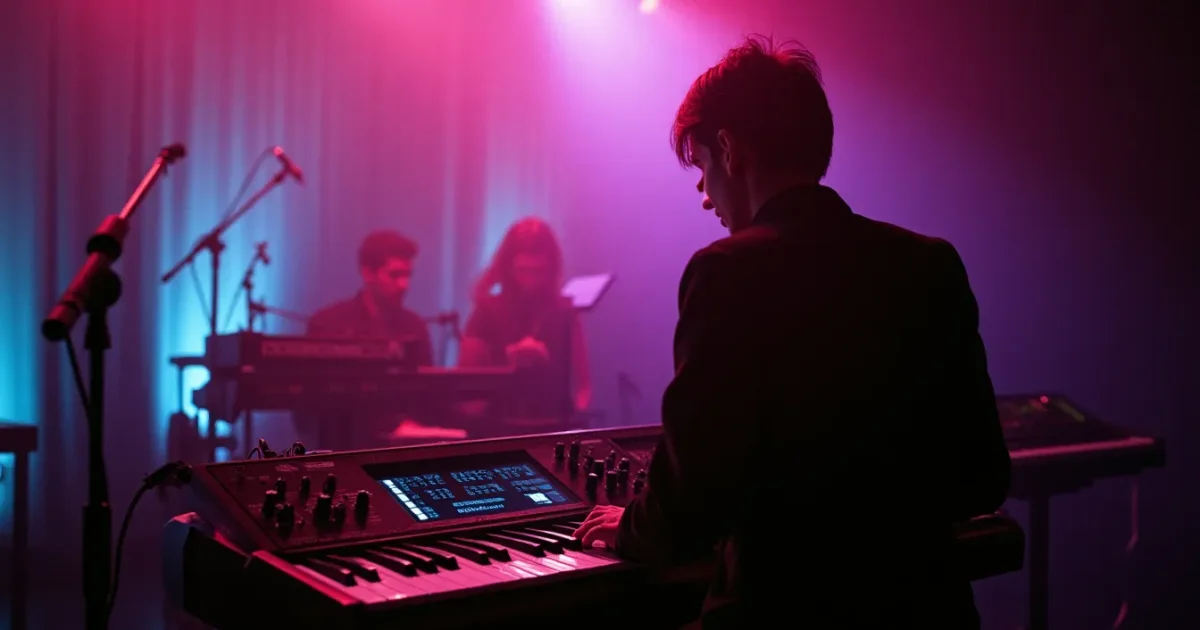
The signature “whistling” sound of the chorus is the Polymoog preset “Vox Humana”. Polymoog (Moog Music, 1975) was one of the earliest polyphonic synthesizers - 71 keys, 14 presets. “Vox Humana” emulated a choral voice through parallel filters and a chorus effect.
Numan used the Polymoog paired with a Roland RE-201 Space Echo - a tape-echo unit adding a characteristic “blur” to every note. That combination - Vox Humana + Space Echo - became the calling card of the entire album and was copied by dozens of artists in 1980-1982 (OMD, Soft Cell, Ultravox).
A detail: the first version of “Cars” was tracked on piano. Numan rewrote it on Polymoog after hearing that Vox Humana sounded “like a car horn in fog”. The lyric is about car safety and paranoia, inspired by an episode in which Numan nearly got into a London accident.
The numbers
- UK: #1 UK Singles Chart (22 September 1979, one week); 2× platinum
- US: #9 Billboard Hot 100 (March 1980); gold
- Canada: #1 RPM, three weeks
- Australia: #1, four weeks
- Germany: #1, two weeks
- France: #18
- Netherlands, Belgium: #3
- Album The Pleasure Principle: #1 UK Albums Chart, two weeks; 1.2M UK copies
- Total single sales worldwide: 3.5 million copies
Spotify 2024 - over 250 million streams. Numan's video (in white suit, at a Polymoog in a foggy studio) - 55 million YouTube views by November 2024.
Press reaction in 1979
The British rock press in 1979 was confused. NME wrote: “This isn't music, it's a soundtrack for the Cold War.” Melody Maker called the album “the sound of a cemetery”. Sounds, by contrast, gave it a rapturous review: “the first fully electronic pop album that works as a pop album, not as an experiment”.
The public responded differently. Numan appealed to teenagers tired of punk manifestos and hunting for music without “social duty”. His look - white face paint, black clothing, emotional detachment - set the template for the new romantic and synth-pop movements of 1980-1983. Without Gary Numan there would be no “Fade to Grey” by Visage (1980), no Spandau Ballet, no Ultravox in the form we know.
Influence on Depeche Mode, OMD, New Order
Four future giants of 80s synth-pop personally cite “Cars” and Numan as inspiration:
- Andy McCluskey (OMD): “I heard "Cars" at 15 and stopped listening to rock that night. A year later we formed OMD”
- Vince Clarke (Depeche Mode): “Numan proved you could make a hit on a Polymoog without a guitar. Without him there's no Depeche Mode”
- Bernard Sumner (New Order): “We studied the Pleasure Principle album by the bar in 1980. It was a textbook”
- Martin Gore (Depeche Mode): “Numan taught me that cold sound can be emotional”
Career after 1980
Numan released two more successful albums - Telekon (1980, #1 UK) and Dance (1981, #3 UK). Then a long dip. By 1984 he was near bankruptcy, trying to sue the IRS over tax disputes. In 1985 he retired from the studio and took up a career as a pilot - performing at British air shows.
In 1994 Nine Inch Nails released The Downward Spiral, where Trent Reznor openly named Numan as a primary influence. That brought Numan back into view. In the 2010s he resumed active work: Savage (2017, #2 UK) and Intruder (2021, #2 UK).
“In 1979 I wanted to be Hendrix. In 1981 - Bowie. In 1989 - nobody. In 2020 I'm Gary Numan again. It took 40 years, but it worked”, - Gary Numan in The Guardian, 2022.
In 2014 Numan went public about an Asperger's diagnosis he'd received in 2011. It explained many elements of his stage persona - the “coldness”, the “detachment”, the difficulty with interviews. He has lived in Los Angeles since 2012, married, three daughters.
“Cars” in pop-music history
The track is the break between two eras. Before “Cars”, British pop relied on guitars and live drums. After it, on synthesizers and drum machines. That opened the door to all the electronic pop of the next 15 years. Without the 1979 Numan breakthrough, “Video Killed the Radio Star” by The Buggles would have remained a lonely experiment; “Fade to Grey” by Visage would not have had an audience; Depeche Mode would not exist.
Related: “Blue Monday” New Order, “Enola Gay” OMD, “Don't You Want Me” Human League. In 2016 Tesla Roadster launched an advertising campaign with the original “Cars” on the soundtrack. The irony: a 1979 song about fear of automobiles selling 2016 electric cars. Numan sold the Polymoog on which the chorus was recorded in 1987 for £2,000 to pay off debts. In 2019 a collector found that same instrument and returned it to Numan. It now sits in his Los Angeles studio, labelled “the one that made Cars”.