1979, London. Gary Numan tops the UK chart with "Are Friends Electric?" - a track recorded entirely on synthesizers, no guitars. A year later "Cars" repeats the success. Numan is not the first to use a synthesizer in pop music, but the first to make it the dominant instrument. Music in the style of synth-pop begins here: the synthesizer replaces the guitar, the drum machine replaces the drummer, the sequencer replaces the bassist. The genre that emerged in 1977-1980 in Germany, Japan, and the United Kingdom dominates the global pop chart by 1985. Twenty tracks below are a map of the genre from precursors to the 2000s revival.
Precursors: 1972-1977
Synth-pop did not arise from nothing. Kraftwerk released "Autobahn" in 1975 - a single that reached #11 on the UK chart. Giorgio Moroder produced "I Feel Love" for Donna Summer in 1977 - a fully electronic disco track with a programmed beat. Yellow Magic Orchestra (YMO) introduced the Roland TR-808 to popular music in 1978. These three records prepared the ground: the synthesizer ceased to be an academic instrument and became a pop instrument.
The birth of the genre: 1978-1981
Ten tracks that defined synth-pop as a genre:
- "Being Boiled" - The Human League (1978): debut single, minimalist electronics from Sheffield
- "Are Friends Electric?" - Tubeway Army / Gary Numan (1979): #1 UK, first synth-pop chart-topper
- "Cars" - Gary Numan (1979): #1 UK, #9 US, synth-pop as an international phenomenon
- "Electricity" - OMD (1979): debut single from Orchestral Manoeuvres in the Dark, a British synth duo
- "Enola Gay" - OMD (1980): anti-nuclear hit that became a dance anthem
- "Don't You Want Me" - The Human League (1981): #1 UK and #1 US, the peak of commercial synth-pop
- "Tainted Love" - Soft Cell (1981): #1 UK, minimalist synth-pop with Marc Almond's emotional vocals
- "Sweet Dreams (Are Made of This)" - Eurythmics (1983): synth bass riff that became the genre's calling card
- "Fade to Grey" - Visage (1980): stylized European synth-pop, influence on italo-disco
- "Don't You Forget About Me" - Simple Minds (1985): synth-rock at the boundary of genres, #1 US
The golden era: 1982-1986
By 1982 synth-pop had become mainstream. The development of affordable polyphonic synthesizers (Prophet-5, Roland Jupiter-8, Yamaha DX7), the arrival of MIDI in 1983, and the rise of MTV created conditions for a commercial breakthrough. British synth-pop groups - the Second British Invasion - dominated the American charts.
- "Blue Monday" - New Order (1983): the best-selling 12-inch single of all time, synth-pop with house elements
- "Take On Me" - a-ha (1985): #1 US, Norwegian synth-pop with an innovative video
- "West End Girls" - Pet Shop Boys (1985): #1 UK and #1 US, a duo that defined late synth-pop
- "Enjoy the Silence" - Depeche Mode (1990): #8 US, synth-pop moving into darker territory
These tracks are the genre's peak. "Blue Monday" by New Order showed that synth-pop could be danceable. a-ha proved the genre worked beyond the UK. Pet Shop Boys fused synth-pop with disco tradition. Depeche Mode showed the genre could evolve toward dark pop and electronica.
Revival: 2000s and 2010s
Synth-pop did not die at the end of the 80s - it retreated into the shadows as house and techno took the dance market. But in the late 90s electroclash revived interest in synth pop, and in the 2000s the genre experienced a broad revival:
- "Heartbeats" - The Knife (2003): Swedish synth-pop with a cold electronic sound
- "Midnight City" - M83 (2011): French electronic pop, a direct heir to the 80s sound
Instruments that defined the genre
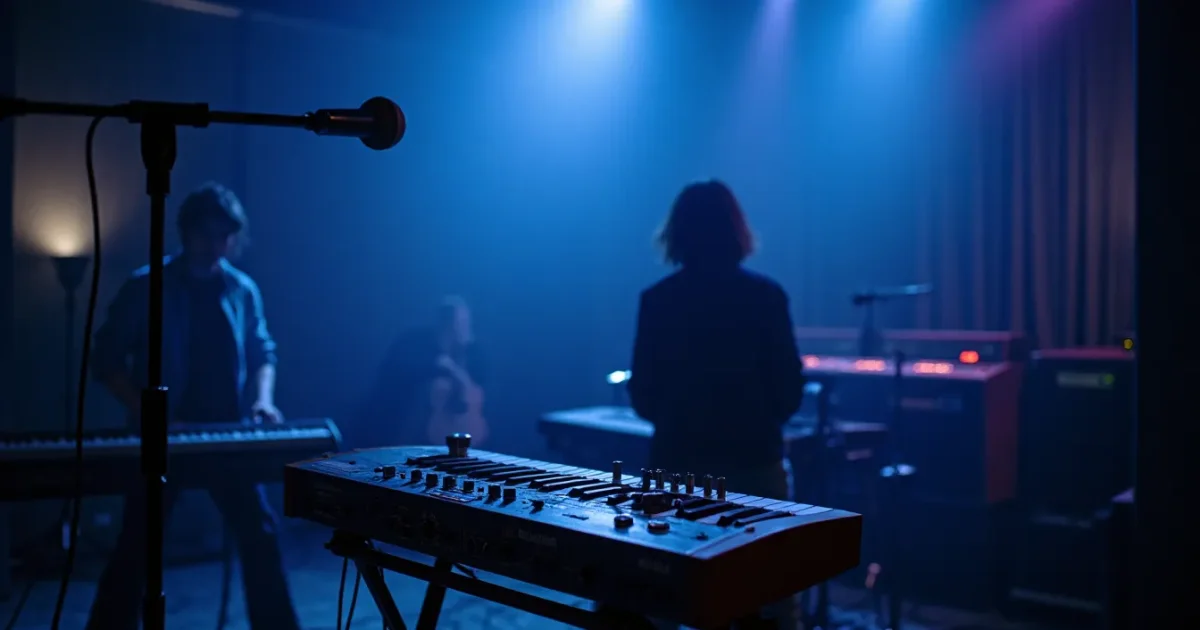
Synth-pop is impossible without three categories of instruments: synthesizers (Prophet-5, Roland Jupiter-8, Yamaha DX7), drum machines (Roland TR-808, LinnDrum, Oberheim DMX), and sequencers (Roland MC-8, Roland MC-4). The development of these instruments in the late 70s and early 80s coincided with the genre's emergence: when polyphonic synthesizers became affordable and drum machines became programmable, synth-pop became technically possible for musicians without classical training.
Many synth-pop musicians had limited musical skills - they relied on technology. The result was often minimalist: simple repeating riffs, often without harmonic progression. This was not a flaw but an aesthetic. Early synth-pop was described as "eerie, sterile, and vaguely menacing" - droning electronics with minimal inflection. But in the genre's second phase in the 80s, the addition of dance beats and warmer production aesthetics made it commercially successful.
The duo model: vocalist plus keyboardist
Synthesizers removed the need for large groups of musicians. Most 80s synth-pop projects were duos: a vocalist plus a keyboardist-programmer. The Human League (later lineup), Pet Shop Boys, Erasure, Yazoo, OMD - all built on this model. The vocalist provides the emotion, the keyboardist provides the technology. This structural division became a defining feature of the genre. Simon Reynolds called the hallmark of 80s synth-pop its "emotional, at times operatic singers" - Marc Almond, Alison Moyet, Annie Lennox. The synthesizer is cold, the vocal is warm. That contrast is synth-pop.
The connection to italo-disco
Synth-pop and italo-disco are related genres that emerged in the same period and used the same instruments. Wikipedia defines italo-disco as a derivative form of synth-pop. The difference is in approach: synth-pop was more song- and lyric-oriented, italo-disco more dance- and melody-oriented. But Italian studios used the same Prophet-5, Jupiter-8, and TR-808 as British ones. Italian producers adopted the British synth-pop model and adapted it for a club audience: the same synthesizers, the same sequenced bass, but with more melodic hooks and less personal lyrics.
Characteristics: what makes a track synth-pop
Synth-pop is defined by three features. First: the synthesizer as the dominant instrument - not an additional colour but the foundation of the arrangement. Second: drum machine instead of a live drummer - a programmable rhythm, often with a flat, "robotic" feel. Third: sequencer patterns - repeating synth figures that serve as riff, bass, and harmony simultaneously.
Lyrics of early synth-pop - isolation, urban anomie, emotional coldness. Lyrics of late synth-pop - love, escapism, aspiration. This shift reflects the transition from post-punk to pop mainstream: the genre began as experiment and became commerce. But structurally - synthesizer, drum machine, sequencer - it has not changed. "Blinding Lights" by The Weeknd (2019) uses the same formula as "West End Girls" by Pet Shop Boys (1985): synth bass, programmed beat, melodic vocal. Synth-pop is a genre that has not aged out because its instruments became universal.
20 tracks: a map of the genre
A consolidated list of 20 tracks that explain synth-pop from precursors to revival:
- Kraftwerk - "Autobahn" (1975)
- Donna Summer - "I Feel Love" (1977)
- The Human League - "Being Boiled" (1978)
- Tubeway Army - "Are Friends Electric?" (1979)
- Gary Numan - "Cars" (1979)
- OMD - "Electricity" (1979)
- Visage - "Fade to Grey" (1980)
- OMD - "Enola Gay" (1980)
- The Human League - "Don't You Want Me" (1981)
- Soft Cell - "Tainted Love" (1981)
- New Order - "Blue Monday" (1983)
- Eurythmics - "Sweet Dreams (Are Made of This)" (1983)
- a-ha - "Take On Me" (1985)
- Pet Shop Boys - "West End Girls" (1985)
- Simple Minds - "Don't You Forget About Me" (1985)
- Depeche Mode - "Enjoy the Silence" (1990)
- Erasure - "Always" (1994)
- The Knife - "Heartbeats" (2003)
- M83 - "Midnight City" (2011)
- The Weeknd - "Blinding Lights" (2019) - synth-pop returns to the mainstream
From Kraftwerk to The Weeknd - forty-four years. Synth-pop was not a genre of one decade: it went through birth, golden era, decline, and revival, and its instruments, rhythms, and melodies sound in pop music today. The twenty tracks above are not a best-of ranking but a map: each adds a new element to understanding the genre - from Moroder's programmed beat to Pet Shop Boys' vocal hook, from early Numan's minimalism to M83's production density.
From experiment to mainstream and back
Synth-pop is a genre that went through a full cycle: from post-punk's marginal experiment to commercial mainstream and back to a niche revival. In 1979 Gary Numan was a strange young man with a synthesizer who sounded like nothing on the radio. By 1985 "Take On Me" and "West End Girls" were in every radio chart in the world. By 1995 the genre seemed dead - displaced by grunge, house, and techno. By 2019 "Blinding Lights" topped the charts with a track structurally indistinguishable from 1985 synth-pop.
This cyclicality is not accidental. Synth-pop is built on instruments that became universal: synthesizer, drum machine, sequencer. When pop music seeks an electronic sound, it returns to the same formula that Numan, The Human League, and Pet Shop Boys developed forty years ago. The twenty tracks above are not a closed list but a starting point. Each works as a key to one aspect of the genre: "I Feel Love" - to the programmed beat, "Blue Monday" - to the dance structure, "Fade to Grey" - to European stylization, "Midnight City" - to nostalgic revival. Listen in order, and you hear how the genre grew, changed, and returned.
This article is a guide, not a ranking. The tracks are selected not by quality but by representativeness: each adds to the picture of the genre a new element not visible in the others. Together they explain why the synthesizer, the drum machine, and the sequencer became the foundation of late-20th-century pop music - and why they remain so in the 21st.
Individual catalogues are mapped in the list of synth-pop solo artists.
Twelve audible criteria are collected in the guide to synth-pop style.