
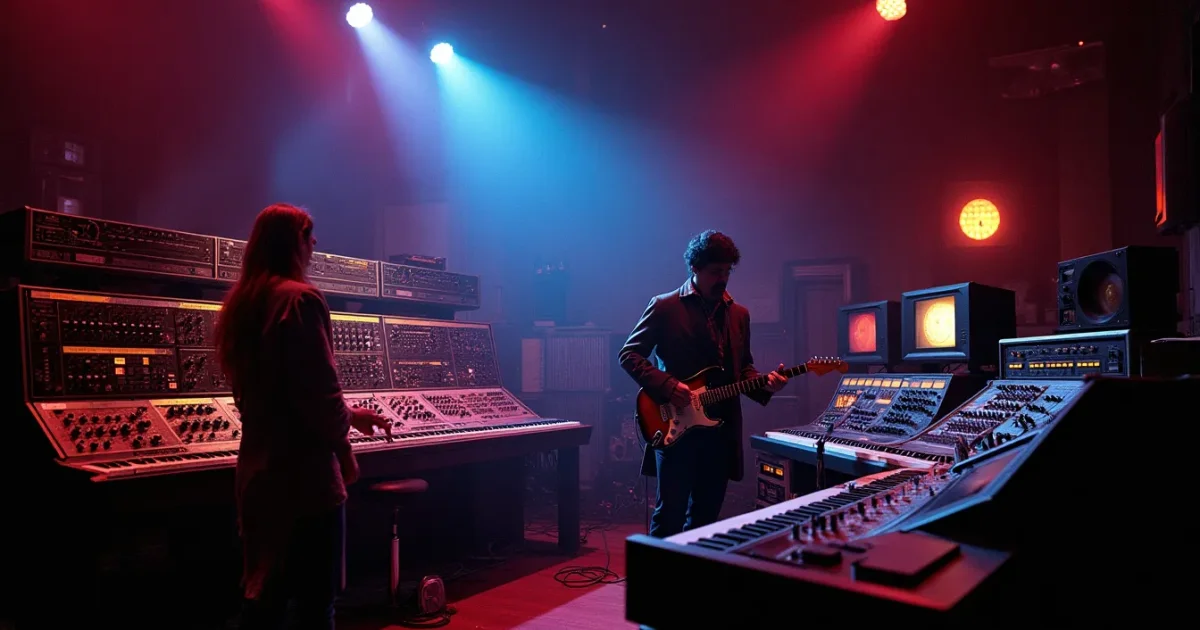
1977. Giorgio Moroder and Donna Summer release "I Feel Love" - a track that Brian Eno will call "the sound of the next fifteen years." The entire backing is built on a single Moog Modular: a programmed beat, synth bass, arpeggios. This is not simply a disco track - it is the first fully electronic disco recording. That same year the French group Space releases "Magic Fly," and Cerrone releases "Supernature." Space disco as a genre is born in 1977, and five records define its sound, aesthetic, and technology.
Five records of 1977
1. Donna Summer - "I Feel Love" (1977)
"I Feel Love" - produced by Giorgio Moroder at Musicland Studios in Munich. The track was recorded in a single session: Moroder programmed the bassline and arpeggios on a Moog Modular, Pete Bellotte wrote the lyrics, Donna Summer recorded the vocal. The result - 130 BPM, steady kick, pulsing sixteenth-note bass, arpeggios in the background. Brian Eno, hearing the track in Berlin, told David Bowie: "The next fifteen years are going to sound like this." He was wrong about one thing: thirty years passed, and "I Feel Love" still sounds like the future.
Technically, "I Feel Love" is the intersection of disco and electronic music. Before 1977, disco was recorded with live musicians: bass, drums, strings, horns. Moroder replaced everything with one synthesizer. This was not cost-cutting but an artistic decision: the electronic sound was more even, denser, and - crucially - had no counterpart in live music. "I Feel Love" reached #1 in the UK, #6 in the US, and became the first fully electronic track to top a chart.
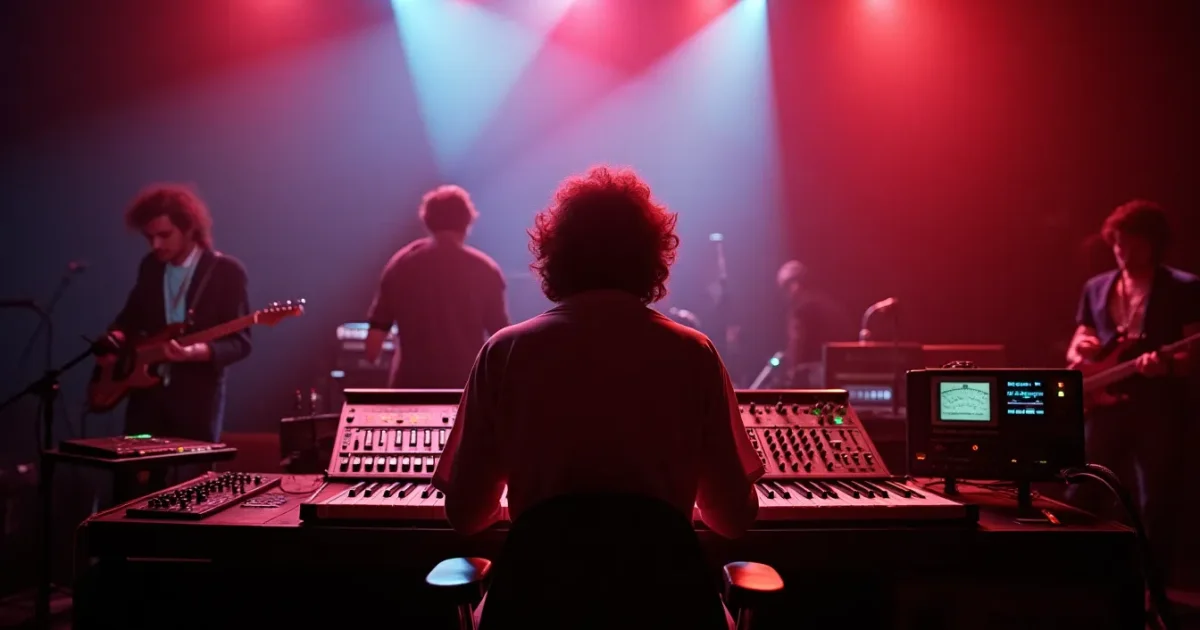
2. Space - "Magic Fly" (1977)
The French group Space released "Magic Fly" in 1977 - an instrumental track with a synth melody, cosmic themes, and a title that defines the genre. Space was a project by Didier Marouani, who combined disco rhythm with electronic textures and a cosmic aesthetic. "Magic Fly" became an international hit and defined the visual language of space disco: space-themed covers, synth pads, melodies that sound like a science-fiction soundtrack.
Space has a direct connection to space disco as a genre - the group's name gave the genre its name. Their approach - instrumental, melodic, without vocals - distinguished space disco from italo-disco, where vocals were the central element. "Magic Fly" is a track where a synth melody replaces the voice: pulsing bass, pad swells, and a lead synthesizer playing a melody that could have been a vocal line.
3. Rockets - "On the Road Again" (1977/1978)
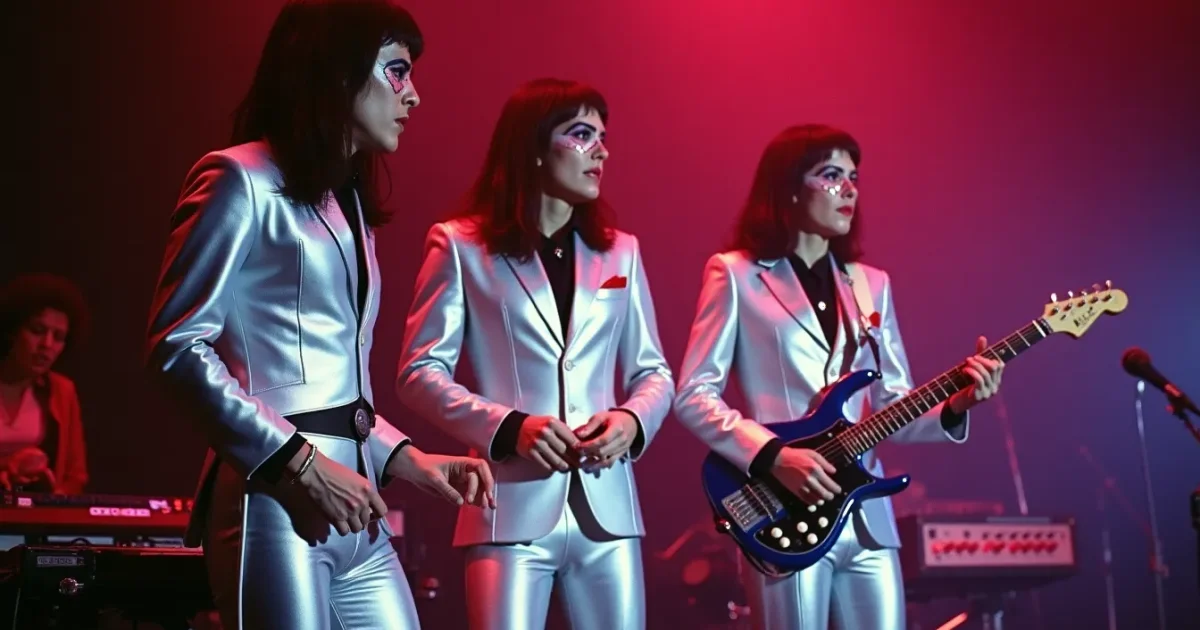
Rockets - a French group that fused space disco with rock aesthetics. "On the Road Again" was released in 1977 (on some markets in 1978) and became the genre's calling card. Rockets looked like cosmonauts: silver suits, makeup, futuristic stage presentation. Their sound - synthesizers over a disco rhythm, with a guitar adding heaviness. This distinguished Rockets from Space: Rockets were a band, not a studio project.
Rockets: silver robots of space disco have already been covered on this blog. Their contribution to 1977 was visual: they showed that space disco was not only sound but image. Silver suits and makeup became part of the genre's aesthetic, later adopted by Koto, Laserdance, and other space disco and spacesynth projects.
4. Kraftwerk - "Trans-Europe Express" (1977)
Kraftwerk released "Trans-Europe Express" in March 1977 - an album that fused electronic music with a concept of European technological optimism. The title track is a minimalist synth melody with a steady beat that sounds like a train. Kraftwerk were not space disco in the strict sense - they were electronic music - but their influence on the genre was direct: Moroder cited "Trans-Europe Express" as an inspiration for "I Feel Love."
"Trans-Europe Express" reached #119 in the US and was not a hit in the conventional sense. But its influence - from Afrika Bambaataa (who sampled it in "Planet Rock," 1982) to the entire Detroit techno scene - made it one of the most important electronic recordings of the 20th century. For space disco, Kraftwerk set the structural template: synthesizer, sequencer, programmed beat.
5. Cerrone - "Supernature" (1977)
Cerrone - a French drummer and producer, released "Supernature" in 1977. The track is disco with cosmic themes, an ecological lyric, and synthesizer elements. "Supernature" reached #1 in France and the top-10 in the UK. Cerrone differed from Moroder and Space: he started as a drummer, and his disco had a live rhythm section with synth layers. This hybrid approach - between live disco and electronic - also influenced space disco.
Detail: Cerrone was one of the first French disco producers to achieve international success. His album "Love in C Minor" (1976) preceded "Supernature" and laid the foundation of the French disco sound that Space and Rockets developed in a cosmic direction.
The technology of 1977: Moog Modular and sequencers
All five records of 1977 share a technological foundation: synthesizers. A Moog Modular for Moroder, Minimoog and ARP for Space, Roland and Korg synths for Rockets, Kraftwerk's homemade and commercial synthesizers, Moog and ARP for Cerrone. In 1977 polyphonic synthesizers were still rare - most recordings were made on monophonic instruments, where only one note could be played at a time. The solution was sequencers, which programmed repeating patterns.
The sequencer of 1977 was not a computer program but a hardware device with a set of potentiometers. Each potentiometer set the pitch of one note in the sequence. Moroder programmed the bassline of "I Feel Love" on a Moog sequencer, tuning each step manually. This explains the evenness of the pulse: the sequencer played the pattern with a precision impossible for a live musician. This "robotic" rhythm became a defining feature of space disco and, later, of all electronic disco.
1977 and the birth of italo-disco
1977 is the year that prepared the birth of italo-disco. The Italian producers who in 1982-1983 would create hits for Savage, Ryan Paris, and Den Harrow were in 1977 young musicians listening to Moroder, Kraftwerk, and Space. Milan's studio infrastructure existed in 1977 too - but it served Italian pop music, not disco. The transition came over several years: once "I Feel Love" proved that electronic disco sold, Italian labels began investing in the genre.
The five records of 1977 are not the first space disco recordings in the strict sense (the genre as a name appeared later), but they set all the elements: electronic sound, cosmic aesthetic, synth bass, programmed rhythm, instrumental melodies. Without 1977 there would be no 1983 - the year italo-disco and space disco became international genres. 1977 is the foundation on which the entire next decade of electronic dance music stood.
The cosmic aesthetic: why space
Why space? In 1977 the cosmic theme was not retro-futurism but current reality. "Star Wars" was released in May 1977 and became a cultural phenomenon. Spielberg's "Close Encounters of the Third Kind" followed in November. The US and Soviet space programs were at the peak of public attention. The aesthetics of space - silver, neon, futurism - were the visual language of the time, and space disco adopted them naturally. Record covers by Space and Rockets, Kraftwerk's visual design, Cerrone's stage image - all operated in the same visual field that connected disco music with science fiction.
For the Italian producers who five years later would create italo-disco, the cosmic aesthetic of 1977 became a visual template. The covers of Discomagic Records, Memory Records, and Time Records releases - stars, synthesizers, neon colours - are direct heirs to the covers of Space and Rockets. Space was not a theme but a visual code that told the listener: this is electronic music, this is the future, this is not a live orchestra but a synthesizer.
The legacy of 1977
The five records of 1977 defined not only space disco but all subsequent electronic dance music. "I Feel Love" is a direct ancestor of house and techno: Moroder's programmed beat became a template for Chicago DJs in the 80s. Kraftwerk's "Trans-Europe Express" is the foundation of Detroit techno and hip-hop. Space's "Magic Fly" is the model for Italian space disco and 80s spacesynth. Cerrone's "Supernature" is the hybrid approach that influenced 90s French house (Daft Punk, Cassius). Rockets' "On the Road Again" is the visual aesthetic that survived into 2010s synthwave.
1977 was not just a year - it was a watershed. Before it, disco was a live genre with orchestras and strings. After it, disco became an electronic genre with synthesizers and sequencers. The five records listed above are five steps across that watershed. Each added its element: Moroder - the programmed beat, Space - the cosmic melody, Rockets - the visual aesthetic, Kraftwerk - the structural template, Cerrone - the live hybridity. Together they are the year that changed dance music forever. Space disco 1977 is not a genre of one year but a point of origin. Five synthesizers, five studios, five producers - and a sound that has not aged in fifty years, because it was built on technology that became the foundation of everything we hear in electronic music today.