Late one evening in 1982, Irene Cara was driving home after the first rough-cut screening of Flashdance. In the back seat sat Keith Forsey, co-screenwriter. Behind the wheel - a Paramount driver. Both had been given the same assignment: write the film's closing song in a week. On the drive from the studio to the hotel, Cara and Forsey wrote the chorus in the car. Ten months later that chorus won the Oscar, a Golden Globe, and a Grammy.
Giorgio Moroder lands the job
In 1982 Paramount Pictures was shopping for a composer on Flashdance - a $7 million film directed by Adrian Lyne. They called Giorgio Moroder, who already had an Oscar (Midnight Express, 1979). Moroder proposed making “not a soundtrack but a pop album”. Paramount agreed, and the contract had a clause: Moroder would write the music, while the studio would add several more songs by other writers so the soundtrack would sound like current pop radio.
For the closing song Moroder called Keith Forsey, with whom he had already worked on Midnight Express. Forsey was a British drummer and writer, familiar with Moroder from Musicland Munich (see our Munich studio deep dive). Vocals went to Irene Cara, who had starred in Fame (1980) and was already proven on scripted pop ballads.
How the chorus got written in the car
After the first rough-cut viewing, Forsey and Cara headed back to Hotel Sunset. In the car Cara started humming: “First, when there's nothing - but a slow glowing dream”. Forsey picked it up on guitar and added an answering phrase. By the time they reached Beverly Hills the chorus was ready: “What a feeling - being's believing”.
The next morning Moroder heard the rough demo on cassette. “I realized the melody didn't need rewriting. My job was to put the right bass and the right drums under it”, he said later in the biography On the Floor with Giorgio Moroder. Over two days Moroder cut the instrumental at Musicland Munich - LinnDrum LM-1, Moog Source on bass, string parts on a Yamaha GS-1.
“We wrote in the car. I hummed the melody, Keith kept the rhythm tapping his knee. By the time we arrived at the hotel, the chorus was done. The rest is Giorgio's work.”
- Irene Cara, The Guardian interview, 1984
Cutting the vocal: one take, three passes
Cara's vocal was tracked at Westlake Studios, Los Angeles, in November 1982. According to engineer Bruce Swedien (who mixed “Thriller”), Cara nailed the main vocal on the first take. Three passes were laid down: lead, an octave above, a breathy whisper in the background. Total vocal tracking time: 90 minutes.
Cara arrived at the session in jeans and a grey hoodie. “I was tired. I'd sung since 8am on a parallel session for another song. I asked for one take and to go home. It worked”, she said in a 1983 Rolling Stone interview.
Six weeks at #1 and the 1984 Oscar
The single came out in March 1983; the film in April. By May “Flashdance…What a Feeling” climbed to #1 on Billboard Hot 100 and held it for six weeks. In France - #1 for six weeks; in Italy - #1 for eight. The UK was cooler: #2, held off by Bonnie Tyler's “Total Eclipse of the Heart”.
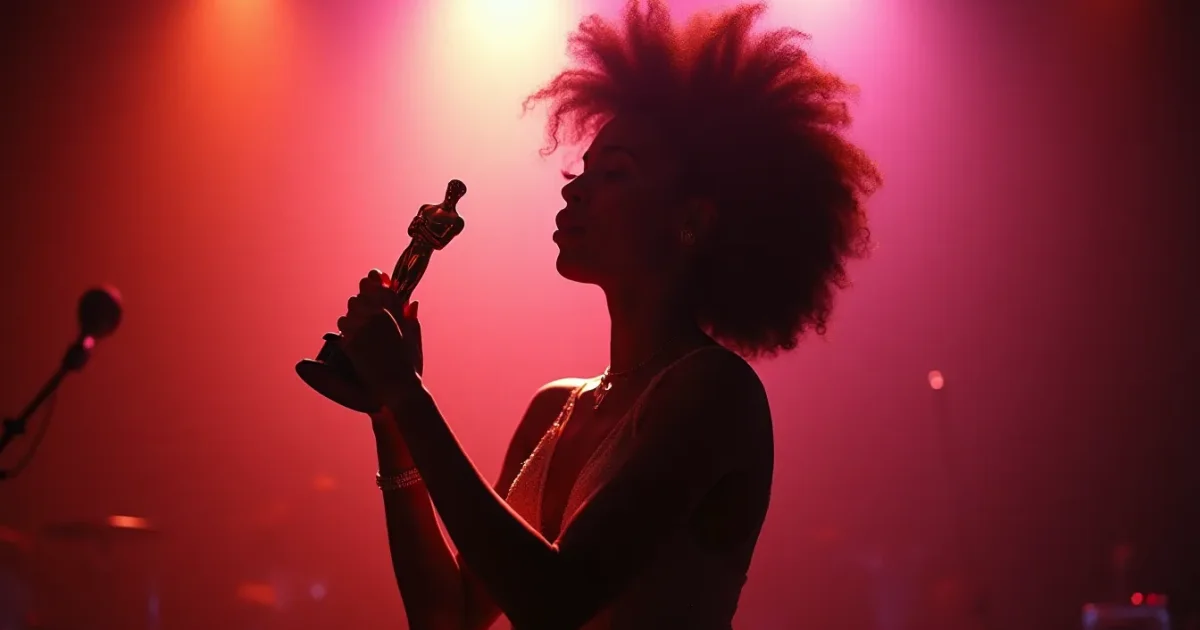
In April 1984 “Flashdance” won the Oscar for Best Original Song. Cara became the first African-American woman to win an Oscar in that category, and only the third to win any Oscar in a music category up to that point. Jennifer Hudson wouldn't arrive until 2007.
At the 1984 Grammys the song took Best Pop Vocal Performance, Female, while Moroder got a Record of the Year nomination (won by Michael Jackson and Quincy Jones for “Beat It” - see our breakdown).
Anatomy of the instrumental
- Key: B-flat minor, modulating up to D-flat major for the final chorus
- BPM: 118 - below the disco pocket, closer to mid-tempo soft rock
- Bass: Moog Source, eighth notes on the root and the fifth
- Drums: LinnDrum LM-1 with a live 16th-note hi-hat added
- Strings: Yamaha GS-1 FM synthesis - not a real orchestra, a preset
- Length: 3:49 (single), 5:44 (12-inch)
- Worldwide sales: over 6 million singles
Moroder's smuggled gift: the key change
The song's main trick is the modulation into the final chorus. It sits in B-flat minor for most of its length; for the last chorus Moroder bumps everything up a minor third into D-flat major. Classic pop move (same mechanic as “Take On Me” by a-ha and Bon Jovi's “Livin' on a Prayer”), but Moroder's version bites harder because nothing before it modulates. The listener sits in minor for four minutes and then drops into triumphant major. Which is literally what the scene demands: Jennifer Beals' character passes the audition and becomes a dancer.
Why the song outlived the film
Flashdance was not a critical success (Roger Ebert gave 2/4 stars). But the soundtrack was. The album stayed on Billboard 200 for two years, sold 25+ million worldwide, and invented the “contemporary pop songs under a movie title” template (Laura Branigan's “Imagination” and Kim Carnes' “I'll Be Here Where the Heart Is” - both from the same record).
After 1983 Irene Cara never matched that level. In 1988 she released the solo album Carasmatic which went largely unheard. She moved to Florida in 2011 and on 25 November 2022 passed away at 63. The coroner's finding: an undiagnosed cardiovascular condition.
Moroder kept working. In 2013 Daft Punk invited him to feature on “Giorgio by Moroder” on Random Access Memories, where he told the same Munich Sound story he had already engineered into “Flashdance” in 1983. The through-line “man who writes melody in a car, turns it into a hit” is Moroder's line, running from 1977 (“I Feel Love”) to 2013.
What to listen to next
For the full 1980s Moroder picture: “I Feel Love” (1977) - the beginning of Munich Sound - and “Take My Breath Away” by Berlin (1986) - Moroder's second Oscar, built with the same “melody → LinnDrum → Moog → star vocal” method. “Flashdance” is the midpoint of that arc: by now Moroder can generate a hit in a single take.